ON JULY 29, IT RAINED money on Dexter Avenue North. That night, there was a fund-raiser spearheaded by Vulcan, the real-estate and investment company owned by billionaire Paul Allen, at a Vulcan-owned office building. The beneficiaries were Seattle City Council members Jim Compton, Margaret Pageler, and Heidi Wills, who together received at least $28,930 in donationsa staggering sum for a single event for city races. In one evening, the council members raised 6 percent of the total contributions they have received in the past four years. Vulcan and its allies say the event was an outpouring of broad-based community support for some of Seattle’s finest leaders. Critics see the fund-raiser as one part of an overwhelming lobbying effort by a fantastically wealthy corporation that threatens to turn Seattle City Hall into a wholly owned subsidiary.
City Council members say Vulcan has launched an extensive lobbying effort, especially in promoting development of the South Lake Union neighborhood. It involves six Vulcan employees and contractors and an alliance of powerful business interests, large nonprofit institutions, and a host of smaller community partners. Notes council member Compton: “Vulcan is all over the place.”
Vulcan spokesperson Michael Nank downplays the company’s role in orchestrating a multi-issue lobbying effort. “It’s community, it’s grassroots. There’s a lot of supporters [for changes] in South Lake Union.”
The Seattle Displacement Coalition’s John Fox, a low-income-housing advocate, thinks Vulcan is running the show. Vulcan’s lobbying campaign “is the most sophisticated we’ve dealt with in terms of the staff assembled and the resources available” over the 25-year history of the coalition, says Fox. “The double whammy, the full-court press, comes when you combine [lobbying] with the [campaign] cash.”
FROM ALL REPORTS, Paul Allen is a quirky guy. Co-founder of Microsoft with Bill Gates, Allen is the fourth-richest man in the world, with a net worth of more than $20 billion, according to Forbes magazine. The holdings of Vulcan reflect his varied interests: the Seattle Seahawks, the Portland Trail Blazers, the Experience Music Project (EMP) museum at Seattle Center, the Cinerama movie theater, and nearly 50 acres of real estate in the area south of Lake Union. Allen began acquiring land in the area as philanthropy to help an effort to develop a large park in the area around Westlake Avenue Norththe so-called Seattle Commons project. If the voters approved the park, Allen would donate the land. But the Seattle electorate twice refused to fund the big park, so Allen began to develop his holdings on his own.
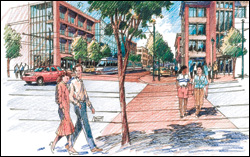
Today, Vulcan wants to transform the neighborhood from a sparse collection of cheap housing, light industry, retail businesses, and office buildings into Belltown on steroids. Vulcan’s Web site explains a vision of South Lake Union as “a new kind of urban community that offers 24-hour opportunities for living, working, learning, and recreationwhile helping to curtail urban sprawl.” Vulcan hopes the employment engine for the area will be biotechnology, and the company plans to develop 10 million square feet of space to make the place run around the clock.
To realize this vision, Vulcan wants the support of the taxpayers. The corporation is actively lobbying for more than $550 million of public investment in the area. The proposed projects include a new Seattle City Light substation and other electrical improvements; a 2.5-mile streetcar linking South Lake Union with the downtown shopping district; transportation improvements to streets, including fixing the “Mercer Mess” of traffic snarls between Interstate 5 and Seattle Center; and the development of South Lake Union Seaport Park. Vulcan’s City Hall agenda also includes things that are harder to price, like extensive zoning changes to support biotechnology and a preferred alignment for the new monorail that would cut through Seattle Center on its way toand throughEMP.
MAYOR GREG NICKELS has wholeheartedly embraced Vulcan’s vision. There appears to be no dissonance between Seattle’s most powerful elected official and the city’s richest landholder.
Members of the City Council are divided on South Lake Union development in general and especially on the particular projects. Council member Pageler sees Vulcan’s plans for South Lake Union as a major business opportunity. She compares it to the mid-1990s redevelopment of the downtown core, which involved Nordstrom, the Pacific Place shopping mall and garage, and Westlake Park. In the 1990s, she recalls, “The big guns came together. A lot of [the plans] were strong-armed by Nordstrom. I don’t think any of [the council members] agreed with all of it, but the outcome was a benefit to allour tax coffers, people who live downtown, and people who shop downtown.”
Council member Wills puts a different spin on today’s plans. She thinks Vulcan wants to build a kind of corporate ecotopiaa neighborhood that combines employment, residence, and environmental stewardship. “We need to embrace the opportunity to support new jobs with housing, transportation, open space, and parks. The next stage is creating a more sustainable city.” Council members Jim Compton and Jan Drago also are generally supportive of the Vulcan vision.
City Council member Nick Licata is skeptical. He thinks the corporation wants to get huge public subsidies to improve the value of its $200 million investment in South Lake Union real estate. He characterizes the push as “a classic land-deal game plan. [Vulcan] has to get the politicians to agree to these changes so it can sell the land.”
Council members Richard Conlin, Peter Steinbrueck, Richard McIver, and Judy Nicastro fall somewhere in between the supporters and the skeptic. Individually, council members have questioned the wisdom of the streetcar, the fix for the “Mercer Mess,” the monorail alignment, and the pace of development. Even Pageler doesn’t support some of Vulcan’s specific proposalslike the streetcareven if she is on board with the overall concept. When it comes to Vulcan’s wishes, there’s plenty of persuading still to do.
VULCAN’S EMPLOYEES and contractors play a central role in moving the company’s City Hall agenda. Vulcan “has hired a lot of people,” according to Steinbrueck. “It’s hard to keep track of them.”
Vulcan’s main lobbyists are former city employees. Vulcan would not allow Seattle Weekly to interview them. Nor would the corporation provide biographical information, citing privacy concerns. But City Council members know them from years of working with them inside government. Vulcan’s director of government and community relations is Lyn Tangen, who was counsel to former Mayor Paul Schell. The company’s manager for community relations and one of the corporation’s chief lobbyists is Phil Fujii, who worked for former council member Cheryl Chow and in the city’s Department of Neighborhoods. The Vulcan lobbyist who council members are most likely to encounter is Government and Regulatory Affairs Manager Dan McGrady, who worked for City Council Budget and Finance Chair Jan Drago for 10 years, according to council sources. McGrady is credited by Wills and Pageler with organizing the $28,000 fund-raiser. Says Cathy Allen, political consultant for Compton and Pageler: “Nobody knows the inner workings of City Hall better than [McGrady] does.”
BESIDES THE FORMER city employees, council members say other Vulcan representatives have visited their offices, too, including EMP spokesperson Paige Prill; former Vulcan employee Jim Kelley, who now has his own firm, Kelley Public Affairs; and Natalie Quick of the Feary Group, another local PR firm.
Housing activist Fox worries about the revolving door between City Hall and Vulcan. “Dan McGrady and Phil Fujii have inordinate access at City Hall” and, as a result, “an inordinate influence over public policy. It’s much easier to sway [council] opinions when you are former staff.”
Vulcan spokesperson Nank, himself a former employee of the Seattle City Council, says Fox’s “comments are totally off base. There is no additional access granted to Vulcan because of the prior positions [employees] may have held.”
Wills says she does not detect any undue influence. “I haven’t seen any red flags yet.” Pageler notes that public employees often switch to the private sector. “People go where things are moving.”
Christine Lea of the Cascade Neighborhood Council, who has lived in South Lake Union for 14 years, says her group, which is concerned about many of Vulcan’s desired changes, cannot get access at all to Compton, Pageler, or Wills. She says her group often doesn’t even receive replies to e-mails or letters. “We get the abrupt cold shoulder,” she says. “The deals are already made, and then they have the public process.” (Lea is a former advertising employee of Seattle Weekly.)
City Council members say that Vulcan also has many important allies who advocate the corporation’s desired changes in South Lake Union. Licata says Vulcan “doesn’t put their point person right up front. They gather their forces and push. It’s a good way to work. It’s sophisticated.”
A good recent example is the campaign supporting the proposed streetcar from Westlake Park to South Lake Union. In June, 30 people signed a letter to the City Council supporting the effort. Only two signers were from Vulcan. Others included neighborhood residents, large corporations like PEMCO Insurance and Bank of America, developers like Harbor Properties and Milliken Urban Limited Partnership, and nonprofits, including the University of Washington and the Fred Hutchinson Cancer Research Center.
Council members also had visits from community groups supporting the streetcar. “I had a delegation in my office talking about the trolley,” says Pageler. “I’m not sure there was even a Vulcan representative” present. Vulcan “wants to take me to Portland” to see that city’s streetcar, she says.
Nank says Vulcan is just one part of a whole group that wants a streetcar. “It’s not just one or two organizations,” he contends. “Smaller businesses, midsized organizations, and large corporations. The larger names may overshadow the smaller players,” but it’s not just a Vulcan agenda.
Vulcan uses a similar coalition approach to fund-raising. Contributions made by actual Vulcan employees only amount to $5,000 over the current four-year election cycle. To ferret out the resources that Vulcan has marshaled, you have to make connections. “All the Vulcan tenants and partners give,” says Matthew Fox, a longtime advocate of slow growth in South Lake Union and former aide to Seattle City Council member Charlie Chong. The donations “don’t all have the Vulcan return address,” he notes.
The July 29 fund-raiser is a case in point. Vulcan’s Nank says the event had 15 or 20 co-sponsors. “It wasn’t just about Vulcan,” Nank says. “It was a great turnout, 150 individuals from all walks of life. Out of that 150 maybe [there were] four Vulcan individuals.”
All of the beneficiaries, howeverPageler, Wills, and Comptonsay Vulcan was in charge. Pageler and Wills say Vulcan’s McGrady set up the event. Compton says, “Vulcan sponsored a fund-raiser. I was delighted with that. Vulcan has every right in the world to encourage us to be good council members.” Other attendees and co-hosts say the fund-raiser was a Vulcan event organized by a Vulcan employee and held in the Vulcan-owned building. Vulcan also mailed the invitations and e-mails promoting the evening.
Based on lists of donors Pageler and Wills say were at the fund-raiser, Pageler received contributions totaling $10,310 from the event, and Wills raised $7,910. Based on an analysis of those names compared to Compton’s list of contributors, it appears he raised at least $10,710 that night.
THE LIST OF DONORS reads like a Who’s Who of Vulcan’s partners and others who have a financial stake in seeing the corporation’s plans realized in South Lake Union. There is also considerable overlap with the signers of the letter in support of the streetcar. The donor lists include employees from developers Milliken, Howard S. Wright, and Touchstone Corporation; real estate companies Trammell Crow Company, Cushman & Wakefield, and Gregory Broderick Smith Real Estate; construction companies Skanska USA Building, Sellen Construction Company, and Lease Crutcher Lewis; architects Callison, Weber + Thompson, and LMN Architects; public affairs firms Bannecker & Associates, the Fearey Group, and TCG Communications; and engineering companies Parsons Brinckerhoff and Hart Crowser.
Licata expresses concern about this fund-raising juggernaut. “What is corrupting about it is this: When you raise that much money from so few people, it limits your ability to ask pointed questions. You begin to put blinders on. It dulls the inquisitiveness of legislators once they become too dependent on the largesse of contributors.”
Compton responds simply, “That’s Nick’s opinion.” Pageler thinks Licata’s analysis is faulty. “Most of [the donations] were not big checks,” Pageler says. “They were mostly $100 checks. [These donors] don’t see it as influence buying.” Wills points out that any support she gets from Vulcan and its friends is balanced by other contributors. “I’ve had broad support from all sidesneighborhood activists, environmentalists, labor. It’s important to listen to all sides because everybody needs to benefit” from changes to the area.
The Cascade Neighborhood Council’s Lea doesn’t believe all sides are competing on a level playing field. “Vulcan, the mayor, and their three buddies on the City Council are laying all the groundwork for the trolley, the substation, and the rezone. They will get it all done because [Vulcan] has this highly professional staff that make sure legislation takes place. We are unpaid. We have other jobs to do. We don’t have the money, time, or expertise to battle that level of interest. There needs to be some kind of mechanism to level the playing field.”