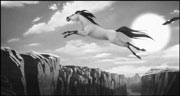
SPIRIT: STALLION OF THE CIMARRON
directed by Kelly Asbury and Lorna Cook with Matt Damon, James Cromwell, and Daniel Studi opens May 24 at Majestic Bay, Meridian, Metro, Oak Tree, and others
GIRLS LOVE HORSES. That’s the can’t-miss marketing idea behind Spirit, the newest animated feature from DreamWorks SKG. So it wasn’t surprising to find the Cinerama packed with preteen girls at a recent invitation-only preview screening. The event was lavishly underwritten by DreamWorks with mountains of food and a special appearance by none other than Jeffrey Katzenberg, the K in SKG, who bravely stood up to introduce the film and its co-directors. It leant a certain quaint road-show feeling to the premiere, a human touch, which all good marketing surely requires.
And Katzenberg is nothing if not a good marketer, having previously produced such animation hits as The Lion King, Prince of Egypt, and a certain little Oscar-winner called Shrek (the second-highest grossing movie of 2001). Moreover, the man has guts, facing down an audience that I, frankly, found terrifying. If Spirit didn’t start on time, I worried, they’d riot like The Day of the Locust. Yet Katzenberg coolly stood his ground like a Jedi in the ring, keeping his remarks short before a surprisingly polite crowd still balancing food-laden paper plates on their tiny knees. (Manners!)
Fortunately the show began on time, and fortunately it’s only 82 minutes long, making it an easily passed test of parental patience. The kids probably won’t notice that the tale is narrated in voice-over by a horse (Matt Damon) who otherwise never speaks. Instead, his bucolic herd emotes with a wide and expressive repertoire of whinneys and neighs. Where are the Bryan Adams ballads coming from? (Do horses sing?) Don’t worry; your children won’t care.
MEANWHILE, YOU can admire the animation, which combines Shrek-style CGI background depth with more traditionally flat animated figures in the fore, like Johnny Quest sneaking into a Renoir. In an interview after the film with Katzenberg and the directors, this fusion of old and new was on everyone’s lips. “Marry the two is really what we try to do,” says co-director Kelly Asbury.
Parents will find Spirit‘s backdrop imagery familiar for good reason, Asbury explains. “We utilized the icons of the American West,” like Glacier National Park, Grand Teton National Park, etc. He further cites “the paintings of Frederic Remington and Charles Russell and Frank Tenney Johnson and James Reynolds and all those great Western artists . . . we wanted to step into those canvases.”
Well, once inside those canvasses, Spirit‘s story is pretty sketchy and one- dimensional. Spirit grows to be a mighty stallion in an American pastoral, but eventually his curiosity leads him from natural idyll to evil civilization, where a mean army colonel (James Cromwell) threatens to break Spirit’s, um, spirit. Parents may briefly feel alarmed when it appears that the blacksmith is about to geld our hero—cover their eyes!–but, no, he only wants to clip Spirit’s mane. Escaping to freedom, Spirit finds that not all mankind is so nefarious; a Lakota (Daniel Studi) treats him kindly and hooks him up with a pretty little filly named Rain. Over and over Spirit returns to its money shot—which is essentially horses running endlessly through romantic landscapes.
This is the kind of family-friendly storytelling, says Katzenberg, that’s driving the animation boom. Yet, he argues, “I don’t really see them as kids’ films. Shrek and Chicken Run and Antz and Spirit—these movies are made very much to work for an adult audience.” (Such assertions were unsupported at the screening where, unlike Shrek, neither parents nor childless critics shared the kids’ rapture.)
So does the animation boom follow the Gen-Y demographic boom? “I’ve never thought of it like that,” Katzenberg avers. Yet he is quite correct in pointing out that while showbiz is cyclical, bad movies never draw an audience—no matter how large their potential demographic. The installed base of preteen horse lovers doesn’t match that of, say, Harry Potter readers, but Spirit‘s small, satisfied viewers have much lower expectations.