Crippled Home Front
Published 7:00 am Monday, October 9, 2006
The willingness with which our young people are likely to serve in any war, no matter how justified, shall be directly proportional to how they perceive the veterans of earlier wars were treated and appreciated by their nation.
—George Washington
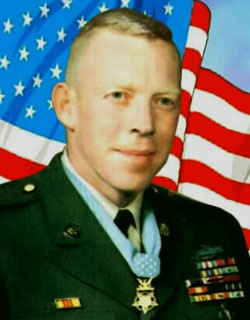
War was his best moment and his worst. Visions of whistling bullets, airborne body parts, screams of the wounded—and that was a good day for Joe Hooper. The Medal of Honor winner and most decorated soldier in Vietnam would bolt upward in his Seattle bed, sweating booze from the night before. Those earlier appearances on national TV, the possibility of a Hollywood biopic, hanging out with Bob Hope and several presidents—that just churned him up more inside. The catlike, strawberry-haired 6-footer and former Washington state football scoring champ at Moses Lake High School had enlisted at age 19 because he admired the military.
Then came Vietnam. Staff Sgt. Joe Hooper, 29, of the 501st Airborne Infantry, killed at least 115 of the enemy—24 of them in a six-hour firefight, lobbing grenades into Viet Cong bunkers and wading through withering machine-gun fire to repeatedly rescue wounded American soldiers. Fourteen out of 189 survived. After treatment for his wounds, Hooper broke out of the hospital to return to his unit. Part American Indian, he said he could smell out the enemy, and thought he was born to go to Vietnam. His 37 medals were more than those earned by World War II’s Audie Murphy and World War Is Alvin York—names that, unlike Hoopers, still ring familiar today. Like others of his era, he arrived home to accusations of being a baby killer. But thats not what eventually soured him on Vietnam. “At high schools, when I speak, the question kids most often asked me was, ‘Would you do it again?'” he told me once. “I would, the reason being I thought my abilities helped save lives. But I would tell my children, if [we] were to do this over, ‘Go to Canada. Dont fight a war you cant win.'”
For decades, vets say, theyve watched their benefits fade in tandem with the diminishing national consciousness of their earlier sacrifices.
In the end, it was Joe Hooper who needed to be rescued. From the day he left the service in 1974 with a $12,000 retirement check carried around in his shoe, his war was with himself and the bottle. Not all soldiers, including the many who were transported from the killing fields to home just a few days out of combat, had his agonizing psychological problems. Overwhelmingly, the average war veteran makes it through decompression to live a normal life. But Hooper wasnt average, nor was his war. (“Vietnam”, says vet and psychologist Jim Goodwin, was uniquely “a private war of survival” by individual soldiers.) Hooper, with two children and a caring wife, was painfully arthritic and 60 percent disabled from his wounds. He sometimes toted around a gun when he boozed. “He drank hard, theres no denying that,” Hoopers friend Larry Frank recalled. “But the VA couldnt deal with him drinking and running around, and thats exactly what the VA is there for, people with problems like Joe’s”. His binges lasted days, and sometimes he was carried out of Seattle bars by military buddies the way he carried the wounded over his shoulders in Vietnam. “When hed get on a tear,” remembered Medal of Honor historian Don Ross of Kitsap County, “Bob Bush [another Medal of Honor winner from Olympia] and I would go after him. It was a constant battle.” In between bouts, the Department of Veterans Affairs (VA) gave him a desk job counseling vets on benefits and then let him go due to “problems adapting to the bureaucratic environment.” In 1979, five years out of his army boots, Joe Hooper was dead from a cerebral hemorrhage. He was 40. The VA eventually was reluctantly persuaded to name a wing of its medical center on Beacon Hill after him, and the Armys reserve center in Bothell now bears his name.
His death was said to be from natural causes. And that’s what scares everyone to this day.
“He was a casualty of war, and you can expect more of the same after Iraq,” says David Willson, a retired Green River Community College librarian, editor of Vietnam War Generation Journal, and a Vietnam vet who worked with Hooper on a collection of war literature. “Look at the history—this is a country made by war on the backs of vets who have never, ever been treated as promised.” Hooper’s story is a lesson on that failure, Willson says. “If we can’t save our heroes, who can we save?”
More Patients, Less Money
For the countrys ex-warrior’s, many of them aged and ailing and thousands of them homeless, medical and psychological treatment is being rationed at home like meals and bullets sometimes were in battle. Last year, the VA, the second-largest government agency (behind the Defense Department) which operates the nations largest hospital system, treated 1.4 million more veterans than in 1996, with 20,000 fewer employees. Since 1995, its hospital enrollments have shot up from 2.9 million to more than 4.5 million annually. At least another 600,000 of America’s 25 million surviving male and female veterans will enroll this year. Some will have to stand in line, others will be refused, and still others may face new $250 enrollment fees. Though hospital and outpatient care are readily available, outreach programs are being downsized, and a lack of funding will force a quarter-million vets to wait up to 10 months for specialized treatment and surgery. Some clinics and hospitals have shut their doors to new patients, and the VA has just closed enrollment to about 164,000 vets who have no service-connected health complications and rank in the VA’s “highest income” bracket (about $35,000 for a vet with no dependents, for example). More than 450,000 disability claims are pending, and vets who are denied face another long wait for appeals decisions.
The future looks even worse: A House Budget Committee is now proposing to cut VA spending by $15 billion over 10 years, starting with $463 million slashed from next year’s budget. Legislators claim they’re cutting fraud, waste, and abuse. But Joe Fox Sr., head of Paralyzed Veterans of America, who calls the cuts “an in-your-face insult to the veterans of this country,” says the reduction will slam the poorest disabled veterans and cut GI Bill benefits for soldiers who are currently serving in Iraq. The plan could also mean the loss of 9,000 VA physicians in a shorthanded VA system, he says.
For decades, vets say, they’ve watched their benefits fade in tandem with the diminishing national consciousness of their earlier sacrifices. “Pressures on the VA health care system,” warns Joe Violante, legislative director for the Disabled American Veterans, “have escalated to a critical point that can no longer be ignored by our government.” He and others recently told the House Veterans Affairs Committee that the VA is underfunded by almost $2 billion. But, in the midst of a stagnant economy, the proposed Bush tax cut, and the Bush war, where would more money come from? Apparently not from George W. Bush.
A week ago, the president summoned leaders from veterans groups to attend his live-TV speech urging on the troops in Iraq. “People serving in the military are giving their best for this country,” Bush said earnestly, “and we have the responsibility to give them our full support. . . .” But while the president’s $62.6 billion supplemental funding would provide fuel and supplies for the troops and benefits for the people of Iraq, Bush didn’t mention that his agenda includes a $150 million aid cut to schools attended by military dependents and support for billions in VA reductions.
Is anyone surprised? Slashing the VA budget is almost a presidential ritual. Ronald Reagan, the celluloid warrior, proposed firing 20,000 VA medical personnel and scrapping part of the VA counseling program—in the midst of a suicidal epidemic among Vietnam vets in the 1980s. Even decorated ex-trooper George Bush pared $600 million from the VA and revoked the lousy $237 once given to families to help bury veterans. (Ironically, one of the vets best friends was the undrafted Bill Clinton, who increased benefits and pay with the Veterans Programs Enhancement Act of 1998.)
“My father,” says Vietnam vet Willson, “a U.S. Marine, came back from Iwo Jima with spots on his lungs from being buried in the volcanic sand there. He never got diddly out of the VA in compensation. They treated him like shit. He was of that generation where you didnt push things much and died in his middle 60s from brain tumors. My great-grandfather was a Civil War vet and spent his postwar years battling to get his $15 pension. I fought with the VA for two years over my son, who was born with spina bifida. I made a claim related to Agent Orange, which they denied—only open-spine condition is covered, not the type he has. My Uncle Frank, a Spanish-American War veteran, used to say, ‘I cudgel my cerebellum trying to figure out how Washington is going to screw the veteran next.'”
Past Wars, Future Patients
With the first wars came the first mystery illnesses—the “irritable heart” of the Civil War veterans, later found to be a psychological disturbance not unlike shell shock in WWI, battle fatigue in WWII, and post-traumatic stress disorder in Vietnam. With new ways to fight wars came new ways to die from them—the ever-growing Agent Orange division of medicine. It took 30 years of Vietnam veteran complaints about toxic defoliants ruining their personal and family health and shortening their life spans before the VA accepted the disorders as treatable diseases. More discoveries continue: Only last year did scientists find a new Agent Orange link to a form of leukemia. Desert Storm vets—about 150,000 returned disabled from the “100-hour war”—are the latest to try to prove their many illnesses are related to the effects of chemicals, radiation, and biological weapons. But the VA says evidence does not support claims that depleted uranium and sarin gas, among others, are culpable. (Storm vets are, however, twice as likely as the general population to develop ALS—Lou Gehrig’s Disease—and treatment for that is now covered.)
Other generations of vets are trying to resurrect their own lost causes. In Florida, for example, ex—POW and Medal of Honor winner George Day has taken a class-action benefits lawsuit to the U.S. Supreme Court. The old warhorse calls it “the crusade of my life”, and I wont rest until the last round is fired,” as he seeks to hold the Navy to its 1914 promise that “during your life, you receive free medicine, medical attendance, and hospital service whenever required.” Day contends the Pentagon breached its contract to continue to provide hospital care for military retirees over 65, forcing them to buy Medicare and other supplemental insurance costing thousands of dollars annually—a prohibitive price for many elderly military or surviving spouses. Retired Army Col. David Hackworth, the columnist and frequent guest on TV’s war channels, describes the government’s history of handing out veterans benefits as “shameful double-talk”, backpedaling, and welshing. American vets, he says, “from our Civil War to Desert Storm have been consistently treated like orphans.” Hackworth, not unlike Joe Hooper, worries most that troops may be politically sacrificed. Hoopers friend Willson says, “Joe would be mighty upset by the politics of this war.” Hackworth is. A member of Soldiers for the Truth (www.sftt.org), which includes citizens and congressional members concerned about troop readiness, Hackworth recently told me: “If you’re not a member and inclined to volunteer for SFTT duty, please do. We still need a few more good men and women. Its only with numbers that we can make the bastards listen.”
Based on his reading of government studies, Hackworth says more than 161,000 Desert Storm vets have been disabled, and almost 10,000 have died from Gulf War—related illness that may have been caused by chemical munitions, oil-fire fumes, untested inoculations, local bugs, or all of the above. Officially, in a January report, the VA said 8,500 direct and indirect combat vets from Desert Storm have since died, but warns in a military voice: “The use of these data to draw conclusions regarding mortality rates will result in inaccurate conclusions.” (There were 148 killed in combat and 467 wounded during Desert Storm.) “Now Bush,” Hackworth wrote in a recent column, “and his war hawks—who almost to a man dodged service in the Vietnam War, just like the majority of our members of Congress—are again sending warriors to employ the military solution in the Gulf at even greater risk, since the Pentagon has just admitted the bio/chem suits our attacking troops will wear are good only for bunker duty.”
Clearly, war casualties arent the making of just our enemies. Like U.S. defoliants in Vietnam, the radioactive residue from U.S. munitions fired at Saddam’s tanks are thought to have contributed to cancer and birth defects among Desert Storm vets—U.S. forces used weapons containing 640,000 pounds of depleted uranium during Desert Storm—all in violation of the Geneva accords, according to a United Nations report. Ralph Nader and others are seeking congressional hearings on the likelihood that troops in Iraq today are traveling through a “zone of death” contaminated by the 1991 war. Last month, U.S. and U.K. officials were reassuring the world that there was little threat from depleted uranium weapons today, even though more than 10,000 allied bombs and missiles, some tipped with depleted uranium, have rained down since Operation Iraqi Freedom began. Other earlier Born-in-the-U.S.A. miseries are still being uncovered, some of them intentionally inflicted on our own troops. The Institute of Medicine last month opened a study to determine the possible long-term effects of biological and chemical agents secretly sprayed during the Cold War on 5,000 servicemen aboard U.S. ships. Including sarin and VX nerve gas, the sprayings were intended to test the effects of another chemical used to decontaminate the ships. That chemical, too, was hazardous.
Politicians Memories
Many war vets say their complaints aren’t about the working folks at the VA or those who staff their hospitals, as I found out during unauthorized strolls through the Seattle VA medical center a few days back (reporters must have clearance, I was later admonished). “My doctor’s great! And the people here are the sweetest,” said a woman who gave her name as Emma and said she was in the Army during WWII. Others echoed that sentiment. The VA Puget Sound Health Care System, which includes the updated 1950’s Seattle hospital on Beacon Hill, American Lake hospital south of Tacoma, and specialty care services to vets in four states, ranks high in the VA system. But it, too, is under pressure from new vets—3,000 more (a total of about 54,000) vets used hospital services here last year than the previous year, and 17,000 new outpatient visits were recorded. “Obviously, we can only work within the parameters of the funding we receive,” says Seattle VA hospital spokesperson Ellen Flores. “But we have a staff that truly cares and an administration dedicated to patient care—the deputy director and chief of staff are veterans themselves.” The state has 670,000 vets, and hospital public affairs director Jeri Rowe says care for some of them is evolving almost daily. “We’ll have more women vets than ever before, and though fewer WWII vets will be here, well have aging Vietnam and Gulf War vets.” The regional system is serving more vets with fewer dollars, she says, “but we’re among the most cost-efficient in the VA system.”
Washington’s congressional delegation, whose districts encompass almost a dozen military bases and 60,000 troops (a third of which are in Iraq), has been sensitive to veterans’ causes, however political their motives may be. Dovish Rep. Jim McDermott, D-Seattle, much maligned by the right for his prewar trip to Iraq, is pushing a bill to study the true effects of depleted uranium. Sen. Patty Murray, D-Washington, criticized by conservatives for voting against the Gulf War II resolution, was subsequently given the American Ex-Prisoners of War’s Barbed Wire Award for her campaign to help vets (she’s the first woman to sit on the Senate Veteran Affairs Committee, and her father was a wounded WWII vet). Rep. George Nethercutt, R-Spokane, who may be planning a run against Murray, recently began handing out medals to survivors of the WWII invasion of Normandy (the medals are made in France, by the way). The eight other state delegates all say theyre fighting for vet rights, too. But why do veterans have to keep reminding us not to forget them?
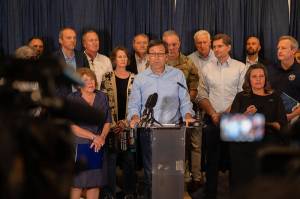
VA Secretary Anthony J. Principi promises better days, and veterans’ groups are pressuring legislators to vote down Republican funding cuts. The VA and Defense Department are now collecting medical data during fighting in Afghanistan and Iraq that could be used to determine causes of future mystery illnesses. Most everyone hopes a nation that supports its troops in battle wont forget them again when the smoke clears.
During my visit to the VA hospital, I went looking for Joe Hooper’s plaque, which I had seen unveiled when a wing was named in his honor a dozen years back. “Joe who?” said a man at the information desk. Others were stumped, too. I couldn’t recall the plaque’s exact location and rode elevators and roamed a mile of hallways unsuccessfully. Last week, public affairs director Rowe told me she had found the plaque in the Addictions Services building, but the area was off-limits to me. She wanted me to know that, if the VA system failed Hooper, it learned from those mistakes. “People back then didn’t give much credence to understanding [post-traumatic stress disorder] and addiction as they should have. I think we know a lot more and have moved forward with a greater understanding.” In that sense, you can say Joe Hooper, even if forgotten, continues to help rescue his fellow soldiers. He is buried, by the way, in Arlington National Cemetery. Near the Tomb of the Unknowns.