On a warm August evening this year, 25 people carrying signs marched up to Gene Sackett’s house. One of them pushed the doorbell.
Sackett, a bald, bespectacled man in his late 60s with an intense set to his eyes, sat for a moment in his living room. His two Abyssinian cats ran for the basement. He knew what was behind the summons to the door and the hubbub of voices outside. Sackett is a primate researcher. And this was war.
Few Seattleites know that within the city sit the twin facilities of the Washington National Primate Research Center of the University of Washington, one of the most prestigious biological research facilities in the country. About $137 million a year in taxpayer money touches the center’s research—equivalent to more than half the yearly revenue of Seattle’s Fred Hutchinson Cancer Research Center. Few know that each year the primate center conducts experiments on about 1,000 monkeys and that almost one-third of those animals die in the cause of advancing human health.
Nor do many Americans know that the National Institutes of Health (NIH) spends $2.1 billion a year on primate research.
But some Seattleites know. Once or twice a year, the more impassioned of them—known alternately as animal-rights advocates or animal “rightists”—march on researchers’ homes to let them hear what they think of the scientists’ life’s work. In recent years, members of the Northwest Animal Rights Network (NARN) have visited the Sackett household four times.
On occasion, Sackett gets anonymous death threats telephoned to his campus office. He fears, as many researchers do, that someday soon an animal rightist will shoot a researcher in the head.
“I’m surprised it hasn’t happened already,” he says. “I’m pretty sure it will.”
To animal advocates, humankind’s use of animals as biological proxies for human ailments is unethical and smacks of slavery. They are especially angered over the use of nonhuman primates in biomedical research. The animals are too intelligent and too much like us, they argue. What’s more, they endure psychological pain. Local advocates dislike Sackett because his research, at times, has involved separating infant primates from their mothers.
But to Sackett, his main work, which tracks the effect of fetal development on the later psychological development of monkeys, is scientifically valid and crucial to humankind. When you can get them to speak, other researchers will tell you that without being able to experiment on primates, many advances in AIDS research would never be made. You simply cannot test an HIV vaccine on a rat, they say. You need an animal more like us.
UNIVERSITY OFFICIALS say the firebombing of UW’s urban horticulture center in 2001 is an example of how matters have spiraled out of control, why the research must go on out of public view.
It’s a kind of cold war, and moments of d鴥nte are rare.
All the same, last August, Sackett opened his front door.
“Would you come out and talk with us?” asked Wayne Johnson, one of the advocates. Johnson has been involved in primate-center protests for 21 years.
Sackett stepped onto the porch.
“If they are going to kill me, then I guess they are going to kill me,” he said when I asked him about it later. “If I end up being the martyr, then what can I do about that?”
Wearing a white sports shirt and white slacks, Sackett leaned against the porch rail and crossed his right leg over his left. Flashes from digital cameras lit up his house. The activists stood just back from his front stairs. Some of their signs showed research monkeys’ heads immobilized by metal frames.
For about 20 minutes, the activists peppered him with questions about primate research, guffawed at many of his answers, but, for the most part, engaged in the kind of reasoned-yet-pointed exchange that lately has been missing from the controversy that has hovered around vivisection for at least 300 years.
No one in Seattle marches on researchers’ homes demanding freedom for mice and rats.
But primates change everything, even for NIH. Officials at the usually accessible $27 billion biomedical research agency in Maryland suddenly become unavailable when you want to talk about primate research. So, too, do primate researchers, who receive the billions of dollars in federal funding.
They fear joining the war, even though its weapons are raw emotion and public lobbying more than violence. Animal advocates aren’t afraid to fight. But researchers are—and they have the most to lose by not taking their case to the public.
That’s because over the past 25 years, there has been a sea change in public opinion. A majority of Americans still support animal research in general, according to a Gallup Poll last May. Asked about primates, however, a slim majority of Americans now believes that our biological next of kin deserve legal rights equal to young children, according to a recent Zogby poll.
OF MONKEYS AND MEN
What compels animal advocates like Johnson to take to the streets is the belief that primate research forces intelligent, social creatures to live in small cages, sometimes for years on end. The animals, he and other advocates say, suffer psychological trauma. Then they are killed.
Researchers say that their hands are tied—there is no better way to get at the mysteries of human biology than through study of a nonhuman primate. They will tell you that society has charged them with going after these answers. The killing, they say, is often a necessary part of the experiments. How else can you look at a primate brain except to kill the primate and remove the brain?
At none of the eight federal primate centers does more killing take place, proportionately, than at the Washington primate center. In 2001, 32 percent of its research animals died due to an experiment or poor health, according to NIH records; at the eight centers, the average is 16.5 percent.
William Morton, the primate center’s director, says that’s because the center does so many experiments, such as AIDS-related work, in which the endgame is a predestined death. At other centers, the animals are cycled into new experiments more frequently.
There is little question that the monkeys who die are not dumb.
Sackett says that the macaques used at the Washington primate center are as smart as a 4-year-old human. Some studies suggest that macaques have the rudiments of language and can solve mathematical problems.
At the Washington center, young monkeys have been trained to use a computer joystick or touch screen to track computerized objects.
“They busy themselves for hours a day—just like kids,” Sackett says.
What interests Sackett isn’t so much what he learns about primate behavior per se, but what it tells him of human behavior and development. It’s a similar story with his colleagues.
What they are doing is basic research. The idea is to find out what makes human beings work on the most fundamental level. Driving this is the central dogma of primate research: What is true for the monkey is true for the human. Nonhuman primates are so closely related genetically to humans (there’s little more than a 1 percent difference between humans and chimpanzees), they can be biological proxies for human beings.
Their cells have a nucleus and chromosomes. Their brains are similar in structure and function, as are their eyes. Female macaques have a reproductive cycle similar to the human one. Primates have similar immune systems.
That makes primates one-stop shopping for researchers.
Scientists, for example, can take 20 macaques, inject them with a potential HIV vaccine, and then hit them with the HIV virus itself to see how they respond. They even use primates to test the effects of recreational drugs. A recent study in primates showed that high doses of ecstasy caused brain damage, for example.
You couldn’t do this kind of research on humans, because society has drawn a bright line between research on animals (where virtually anything goes) and research on humans (which is much more constrained).
“The crux is, really, if we want science to pursue things that will improve the quality or length of our lives, then the question becomes how best do we do that?” says Clarence Braddock, associate professor of medicine at UW, who also teaches medical ethics.
Research supporters say there are perfectly good reasons to enlist primates in research.
“If you have a therapy that could potentially be dangerous for humans, like genetic therapies, some of those things would be much better attempted in a primate that allows you to explore them before you bring them to humans,” says Judy Stern, an associate professor of OB/GYN at Dartmouth Medical School in Hanover, N.H. Stern also teaches bioethics.
The effect of not having primates available for scientific research, researchers say, would be devastating.
“The progress in diseases such as Parkinson’s and Alzheimer’s would slow, if not come to a halt,” says Taylor Bennett, associate vice chancellor for research at the University of Illinois at Chicago.
Much of that research happens at the eight national primate research centers from Oregon to Georgia. There also are publicly funded primate facilities at universities such as the University of Louisiana at New Iberia and the University of California at San Francisco.
The research has always been controversial in some quarters.
“It’s the nature of the animals they are doing the research on,” says Martin Stephens, vice president for animal research issues for the Humane Society of the United States. “They are carrying out a controversial activity, animal research, on the species that’s at the center of the controversy.”
It didn’t start that way.
The primate centers trace their roots to the 1950s, a time when it was believed that the Soviet Union had bested America in scientific research. It had a successful space program as proof. To help close the gap, the U.S. undertook massive spending on basic science.
By the mid-1960s, the seven original primate centers had opened (the eighth was added in 1999). The centers focus on everything from AIDS to vision research.
The Washington primate center opened in 1961. It keeps about 800 monkeys, valued at $3,000 each, in two facilities in Seattle—450 on the UW campus and 350 at a facility in the city’s Belltown neighborhood. Another 1,200 Washington monkeys are quartered at the Tulane National Primate Research Center in Louisiana, in a breeding colony, for future research in Seattle.
The center also has another 2,500 monkeys in a breeding colony in Indonesia.
But it’s the Seattle monkeys, the ones who live in the cages, that bring the animal advocates out on warm summer nights with their signs.
AIDS, SMALLPOX, AND ANTHRAX
Up to the mid-1970s, animal researchers didn’t have to contend with animal advocates showing up at their homes. It was a time when science had won the war. Scientists could perform experiments with almost total disregard for the animals they used.
“We did experiments that, when I think back on them, I cringe,” says Dartmouth’s Stern.
The tide began to change in 1975. That’s when ethicist Peter Singer published a book called Animal Liberation. His argument was that humankind engaged in tyranny over animals every day. He called it “speciesism.” It was best seen, he thought, in the slaughterhouse and in the research laboratory.
Animals, he wrote, had rights equal to humans.
Owing to a shift in public sentiment that followed, researchers slowly began to use fewer animals. Congress passed a law requiring better living conditions for research animals, partly in acknowledgment of the psychological complexity of primates.
In 2000, 46 percent fewer dogs, cats, and rabbits were used in research than were used in 1975, according to the U.S. Department of Agriculture. (Rodents are a different story; their numbers are not monitored.)
In terms of sheer numbers, animal advocates have not succeeded in their efforts to keep primates out of the lab. Researchers used 57,518 primates in 2000, compared to 36,202 in 1975, according to the USDA—an increase of 59 percent.
I asked Morton, the Washington primate-center director, what research was driving the increase. He’s a balding man, quick to laugh, who wears crew-neck sweaters on warm days and speaks with the soft accent of his native Maine.
He said that much of the increase in research on primates has been driven by AIDS work. He added that the trend would accelerate because of the revolution in molecular biology flowing out of the Human Genome Project.
“That’s the way the future is going to go,” says Morton. “You’re seeing a lot of basic genetic and immunobiology-related work done initially in rodents, and then that research will be translated into primates, which are much closer to humans.”
BUT THERE’S another reason why more primates might wind up staring out of small cages. NIH’s nascent bio-defense research program will use primates as the test subject of choice for smallpox and anthrax vaccines.
“That is going to dwarf AIDS research,” Morton says. “That is going to demand more primate usage.”
NIH officials would not provide details of how much they will spend on bio-defense research or how many more primates they anticipate using.
Animal advocates are already alarmed, particularly since many researchers have recently hectored NIH. There aren’t enough research monkeys to go around, they say, and we need more. Soon.
“That’s the concern—that primate use is going to increase at a time we want to see it decrease,” says the Humane Society’s Stephens. “When people start talking about a crisis in the supply of primates, we get nervous.”
More-radical elements in the war, like the Northwest Animal Rights Network members who showed up at Sackett’s house last summer, don’t have such a conciliatory attitude. They would like to see animal research end altogether.
“We have no right to put primates in jail,” says NARN’s Johnson. “We don’t have any right to cause pain and suffering to another feeling, sentient being, whether mice or primate. But, despite the gloss they put on it, that’s what they are doing” at the Washington primate center.
Others, like the Humane Society, take a more moderate view and work within the legislative system to change laws governing animal use and welfare.
Still, the environment around primate research is so fouled that even researchers, who say they care for the animals they use, won’t talk publicly.
For more than two months, I tried to get primate researchers to talk openly and honestly about their work. I wanted to bypass the public-relations filters, officials, and spokespeople through which the research community fights its side of the war. My hope was that scientists would explain how primate research works and why it justifies billions of dollars a year in taxpayer money. I approached dozens of researchers and several research universities. Only Gene Sackett agreed to talk at length. “I can’t afford to expose my family to hostility, and I must admit that even ignoring frank hostility, I can’t afford the time it would take to respond to letters and phone calls that your article might generate,” one researcher wrote in an e-mail exchange.
“As I already have been picketed by animal-rights groups, I hardly need more exposure,” wrote another, who had agreed to be interviewed. “Therefore, I am canceling our meeting.”
Says Dan Page, a spokesperson for the University of California at Los Angeles School of Medicine: “It’s a conundrum for these doctors. If they get out in front and speak out for their research, then they become targeted.”
Part of what’s driving this must be a sense that their research doesn’t market well. So why whip up attention by defending the work?
For example, one common procedure—done in slightly different ways at UW and institutions around the country—involves tracking monkey eye movements and measuring brain activity. To do this, a veterinarian fits a coil around one of the monkey’s eyes; sometimes the coil is implanted in the eye. Then part of the skull is removed and covered with a plastic cap. The cap has an opening in it. The monkey is also fitted with a head restraint, attached to bolts on the monkey’s head. The monkey is then secured in a restraining chair and shown a number of objects on a screen, which the animal then tracks with a joy stick. At times, electrodes are implanted in the monkey’s brain.
Sometimes, these procedures go on for months with the same monkey. Then the monkey is killed and his brain is removed and sliced for examination.
Such research is what summons many advocates to action and prompts some primate-center employees to question how these primates are treated.
A BLUR OF FUR
On a sunny afternoon last June, I met Rachel Snyder at a coffeehouse on Seattle’s Capitol Hill. She is a short woman with black hair who wears black-rimmed glasses and has two tattoos of fiery motor scooters near her collarbone. She had recently resigned from the primate center, after working there for about a year as an animal technician in preparation for entering college in the fall.
Her job was to feed hundreds of monkeys twice a day and clean their cages.
One incident at the center had driven her, she said, to go public with complaints about how the center took care of its animals. She described how one day, while making her rounds at the center, she found a male monkey in a blood-splattered cage. The monkey had bitten into its own leg muscles, she said. Emotionally, Snyder recounted how she called for help from other animal technicians and veterinarians, but that no one came for what she considered a long time.
The monkey was later euthanized.
The syndrome Snyder witnessed is called self-injurious behavior. It affects some humans with autism, and it afflicts nonhuman primates, too. Researchers don’t know the cause. In research monkeys, at least, it occurs most frequently in those who live in single cages—as 75 percent of the UW monkeys do.
Monkeys are social creatures, often spending much of their time grooming other monkeys. Removing that social contact and confining them to small spaces can drive some monkeys to the point of self-mutilation. Even more common than monkeys biting themselves are monkeys who pull out their own hair, known as “over-grooming.”
Morton, the Washington primate center’s director, admits that such behavior is, to a degree, an unavoidable aspect of the research environment.
Primate experts consider self-biting and over-grooming to be indices of pain and distress. That’s exactly the point animal advocates try to make: These animals, because of their intelligent nature, suffer real psychological pain.
The federal Animal Welfare Act calls for special handling of “the psychological well-being” of primates, a term that the act leaves undefined. One of the accepted treatments at primate facilities is to keep a monkey’s mind occupied. Primate centers like Washington’s go to great lengths to do that. They give the monkeys balls and other toys. They put their monkey chow in puzzle feeders, so that the monkey has to work to get at his food. They even provide “grooming boards,” the equivalent of a cat’s scratching post.
SMOKING A CAMEL cigarette, Snyder told me that often none of that seemed to do much good for the primates.
“There were tons more displaying neurotic behaviors like flipping,” she said, describing how caged animals flip themselves end over end or spin like a top—sometimes so quickly that they become a blur of brown fur.
I asked her why she thought the monkeys were flipping.
“Well, they’ve got to do something,” she said, “because they don’t get any exercise.”
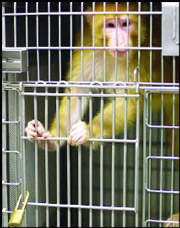
At primate centers, research animals spend almost all of their time in their cages in windowless rooms. It is not uncommon for the cages to be no larger than 4.3 square feet. They get no exercise, nor does federal law require that they do. Often, the only breaks in their caged existence come when technicians enter the room to feed the animals and clean their cage bottoms of feces or when technicians come by to take blood samples from monkeys involved in HIV studies, for example.
Another former primate-center animal technician, who requested anonymity, buttresses Snyder’s account.
“As a rule, there were very few monkeys, a handful at the whole facility, that could be said to be psychologically healthy,” says the former employee. “Most of them had some kind of neurosis; there were very few who didn’t.”
I asked Sackett about self-injurious behavior. Could self-injuring primates be used to answer the mystery of why some humans bang their heads against walls and bite themselves? Could these monkeys be yet another nonhuman-to-human primate model?
Sackett said they could.
“But I don’t think any scientist would have enough nerve to do that,” he said. “They’d be afraid of being killed by animal-rights people. They’d be afraid for their families.”
THE HARVEST
A map of the Indonesian archipelago hangs on one of Morton’s office walls at the primate center, representing just how global the research-monkey trade has become and the lengths to which some centers go to get more monkeys for more research.
Across the nation, the demand for research primates outstrips supply. Most primate centers, such as ones in Louisiana and Oregon, have enough available land to establish large colonies of monkeys bred for research. Pinched for space in Seattle, the Washington National Primate Research Center doesn’t have that option. Compounding matters, Morton says, the center’s breeding colony in Louisiana doesn’t produce enough animals.
Morton goes over to the map and points at a speck of an island off the southwest Javanese coast. There, in 1991 on Tinjil Island, amidst its palm trees and steambath humidity, the center opened a breeding colony in cooperation with an Indonesian university.
“There were no primates on the island to begin with,” says Morton. Monkeys captured elsewhere made up Tinjil’s initial population. There are now 2,500 monkeys, mostly crab-eating macaques.
“For my money, I think that’s the prototypic way that primates should be produced,” says Morton.
Each year, 50 to 100 macaques are rounded up—or harvested, in Morton’s vernacular—and shipped to Jakarta. There, they are packed in cages and wooden crates for a flight to the United States. Food and water are placed in their cages.
The Washington center also has smaller programs in Russia and Nepal.
None of this sits well with Shirley McGreal, a longtime cold warrior. She’s executive director of the International Primate Protection League, based in Summerville, S.C. For 30 years, she has tracked the international trade in everything from chimpanzees to gibbons and has been a regular thorn in the side of the research community and primate importers.
“They shouldn’t be bringing in animals from Indonesia,” she told me. “They are living semi-free. These international trips for monkeys ought to be a thing of the past.”
SEATTLE WEEKLY has learned of one aspect, in particular, of monkey importation that raises concern.
Since the summer of 1998, 24 primates destined for the UW in Seattle were dead on arrival. In August 1998, for example, 11 pigtail macaques, out of a shipment of 40 from Indonesia, were found dead at San Francisco International Airport, according to records kept by the Centers for Disease Control (CDC). The causes of death were listed as heat and dehydration.
Two years later, a baboon from Russia showed up dead at Seattle-Tacoma International Airport, a victim of a lung ailment, according to CDC records. This year, 12 monkeys in a shipment of macaques were D.O.A. at Los Angeles International Airport.
Thomas DeMarcus, the CDC official who oversees primate importation, says that such a number of deaths is rare. From October 1997 to September 2002, almost 70,000 primates were imported into the United States. The overwhelming majority of them were headed for private companies, such as Charles River Laboratories and Covance Research Products, which either use the animals in their own experiments or resell them for use in research.
The Washington primate center commonly imports fewer than 100 animals a year.
In the same five years, 79 primates have arrived D.O.A. on American shores. Thirty percent of those deaths were among monkeys destined for Seattle, an amount far out of proportion to the number of primates the center imports. In 2002, the Washington National Primate Research Center imported about 0.5 percent of all primates brought into the United States but accounted for 60 percent of the deaths, according to CDC records.
“Any time we’ve had that happen, it’s been an airline-related incident,” Morton told me, adding that it often stems from heat buildup in airplane cargo holds while a plane sits at an airport during a layover.
“We don’t like it,” he says. “We are very concerned about it when it does happen.”
WHO’S A TERRORIST?
UW officials make it clear that they consider the tactics of groups like the Northwest Animal Rights Network to be flirting with terrorism. What’s more, the university and the Washington primate center claim to be so concerned about security that they declined my repeated requests to even see the primate center’s monkeys. That struck me as odd. How could a reporter, escorted, be a security threat? I also argued that the university and the primate center get hundreds of millions of dollars a year in taxpayer money—and that the public has a right to know how its money is spent. That’s especially true if the public wants to conduct an informed debate of the merits of the research.
The university was unmoved.
The heightened concerns about security are the result of a string of incidents: A window kicked in at the primate center in 1997. Razor blades received in the mail in 1999. The firebombing of the urban horticulture center in 2001 by the Earth Liberation Front. A threat that members of a committee overseeing animal research at the university had better watch their backs, made by an animal-rights advocate last March. The recent demonstrations at the homes of Sackett and two other primate researchers.
L.G. Blanchard, spokesperson for the UW Health Sciences Center, repeatedly told me that researchers are in the crosshairs of animal advocates and that visits, however peaceful, to researchers’ homes have upped the ante.
In an interview earlier this year, Susan Adler, executive director of the Washington Association for Biomedical Research, said that she sees the Northwest Animal Rights Network as a conduit for the Animal Liberation Front. She has no evidence that this is the case, she admitted.
“We certainly are not terrorists, and we’re not trying to terrorize anybody,” says NARN’s Wayne Johnson. “The real terror is done to the animals in those labs. We’re going to use every legal means to let UW know that what it is doing with millions and millions of our tax money is simply wrong.”
Nationally, there are pressure groups on both sides of the cold war. The National Association for Biomedical Research and the Foundation for Biomedical Research, both pro-research groups, try to influence public opinion through educational outreach and advertisements. The former group also lobbies Congress to not tighten restrictions on the use of animals in research. (For a complete list of organizations on both sides of the debate, visit Seattle Weekly online at www.seattleweekly.com.)
PITTED AGAINST THEM are groups like the Humane Society of the United States and People for the Ethical Treatment of Animals (PETA). The Humane Society, a moderate group, focuses its efforts on incremental legislative change. PETA, a more radical group, agitates for an immediate end to animal research.
Researchers are largely winning the war by dint of the fact that, each year, they are doing more research on more primates.
But earlier this year, In Defense of Animals, a California-based animal-rights group, won an unprecedented victory—it essentially forced the closure of a primate research facility in New Mexico.
Known as the Coulston Foundation, it was home to several hundred chimpanzees and had been fined three times by the USDA for violations of federal regulations. For example, a chimp had died after being left outside in desert heat. Still, NIH continued to fund Coulston. In Defense of Animals applied so much pressure through Congress that, in 2001, NIH finally pulled its money out of the research facility. Early this year, the foundation’s bank called in a loan, putting the facility out of business. A Florida sanctuary acquired the last of the Coulston chimpanzees in September.
Locally, NARN often has taken a broad-brush approach to battling animal research in all its forms and has tried to elicit public sympathy and support. It has lumped mice in with primates. The small nonprofit has found little traction there.
Che Green, a NARN organizer, says that it’s hard to get the public wound up about rats and mice. So the group is shifting its focus to research primates at the Washington primate center. It also has more plans to protest at primate researchers’ homes, perhaps even at Gene Sackett’s house.
And, then, it will be war all over again.

A Moderate Ethic
There was a time when few would question the ethics of primate research. Those were the days when researchers like Harry Harlow—who forced young monkeys to live alone in darkened chambers, driving them mad—could do essentially anything they liked with society’s tacit blessing.
That changed with the rise of the animal-rights movement in the mid-1970s. The movement began with the assumption that animals have rights equal to humans and that to use them in experiments is unethical, an act of tyranny. The movement’s philosophical godfather was Australian ethicist Peter Singer. The primate research community’s stance shifted somewhat. Experiments once approved by the National Institutes of Health were not funded. Still, primate research continued, operating under the ethical premise that to not experiment on primates would be unethical—otherwise, how would you go about saving human lives?
For much of the past 25 years, the two extreme camps have hardened their positions. Getting much less attention is a more moderate set of ethicists who see primate use as a special case in the animal-rights debate. John Gluck, a psychology professor and bioethicist at the University of New Mexico, is one of them. Gluck was a graduate student under Washington primate center researcher Gene Sackett while Sackett was at the University of Wisconsin. Gluck co-authored journal articles with Sackett on primate behavior, until he turned his back on primate research.
“The ethical landscape is a lot more complex than the average primate researcher would take it to be,” he says. “These are complex beings who feel pain and make choices. The standard has to be higher (than for other animals), if for no other reason than we know of their ability to experience pain.”
He shudders when he thinks about past experiments he and other researchers did.
“In a way, we didn’t know better,” Gluck says. “Our consciousness hadn’t been raised by people like Singer.”
Gluck argues that since primates have a thinking, feeling life, researchers who skirt ethical considerations that include the animal are morally out of touch. “I consider people who don’t pay attention to it to be blameworthy,” he says. “Now, they have to turn their back and say, ‘This is irrelevant to me, it’s irrelevant to my study, it’s irrelevant to my animal.’ I don’t see how you can get there now with the sophistication of ethical perspectives. That’s a betrayal of science and ethics.”
The credo of the moderates might be: Experiment if you must, but do everything to protect the innate character of the primates and not let them be turned into laboratory freaks. A thumbnail sketch of the argument is given by Bernard Rollin, an ethicist at Colorado State University, in his formulation “bird gotta fly, fish gotta swim.” And monkey, presumably, gotta be in social groups.
There is some evidence that the research community has begun to soften its stance.
Until recently, if researchers were finished using a primate in AIDS-related work, they would simply kill the animal, even if it had shrugged off the illness. It was infected with a form of HIV and that made it a time bomb around other primates. That put researchers—and particularly NIH—in a bind. Many of the animals infected with HIV were chimpanzees, and they didn’t progress to full-blown AIDS, making them lousy research models from a scientific perspective. Still, the chimps were infected with HIV. Could NIH justify killing these highly intelligent creatures?
A National Research Council panel found that the agency had a moral obligation to keep the animals alive in recognition of their high intelligence and intricate social lives. In 2000, Congress passed the Chimpanzee Health Improvement, Maintenance, and Protection Act, which set up a system of sanctuaries for the 1,300 retired chimps still in NIH’s hands. The first 200 chimps will be retired to a sanctuary in Louisiana in 2004.
Philip Dawdy
THE ADVOCATES
ANIMAL RIGHTS
HUMANE SOCIETY OF THE UNITED STATES
Location: Washington, D.C.
Annual income: $65,474,670
Comments: A moderate group that seeks stronger regulation of research. It’s currently pressing the U.S. Department of Agriculture to enact stricter rules concerning pain and distress experienced by research animals.
Web site: www.hsus.org
IN DEFENSE OF ANIMALS
Location: Mill Valley, Calif.
Annual income: $1,904,833
Comments: A radical group that calls for an end to the use of animals in medical research and to the human ownership of pets. It is widely credited with pressuring Congress and the National Institutes of Health into shutting down the notorious Coulston Foundation in New Mexico.
Web site: www.idausa.org
PEOPLE FOR THE ETHICAL TREATMENT OF ANIMALS
Location: Norfolk, Va.
Annual income: $13,867,001
Comments: Seeks to end the use of animals in medical research. Best known for its provocative advertisements and publicity stunts. PETA investigates animal cruelty at farms and circuses and promotes vegetarianism.
Web site: www.peta-online.org
NORTHWEST ANIMAL RIGHTS NETWORK
Location: Seattle
Annual income: $15,498
Comments: Grassroots group founded in 1986. Active on a number of fronts, including fur and circus protests as well as promoting veganism. It calls for an end to the use of animals in medical research.
Web site: www.narn.org
ANIMAL LIBERATION FRONT
Location: unknown
Annual income: unknown
Comments: Radical group calls for complete animal liberation and is known for its laboratory break-ins. Law enforcement officials have been frustrated in their search for ALF saboteurs, arresting only a handful over the past 20 years.
Web site: www.animalliberationfront.com
RESEARCH
FOUNDATION FOR BIOMEDICAL RESEARCH
Location: Washington, D.C.
Annual income: $1,438,642
Comments: Advocates unfettered use of animals in medical research. Also operates the National Association for Biomedical Research.
Web site: www.fbresearch.org or www.nabr.org
FEDERATION OF AMERICAN SOCIETIES FOR EXPERIMENTAL BIOLOGY
Location: Bethesda, Md.
Annual income: $15,636,860
Comments: A coalition of life-science and biomedical organizations.
Web site: www.faseb.org
WASHINGTON ASSOCIATION FOR BIOMEDICAL RESEARCH
Location: Seattle
Annual income: $363,099
Comments: One of many state-level industry advocacy groups. Works primarily as an educational outlet, informing the public about the benefits of biomedical research using animals.
Web site: www.wabr.org