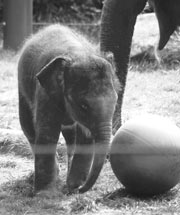
LAST WINTER, during an unusually sharp November chill, tens of thousands of Seattleites shivered in line for hours to get a brief peek at the city’s new favorite celebrity: a 235-pound baby elephant. This weekend, thousands more will turn out to celebrate Hansa’s first birthday. Zoo managers, politicians, and business sponsors will salute the half-ton bundle of adorability as a conservation triumph. But for Seattle’s elephants, Hansa’s birth is a decidedly mixed blessing. For their endangered species, beset by everything from ivory poachers and land-grabbing plantations at home to herpes and tuberculosis epidemics in this country, captive breeding offers no conservation panacea—just a tangle of troubling questions and difficult trade-offs.
To understand those trade-offs, you need a sense of the stakes. More than other zoo animals, more than almost any trophy save skyscrapers and sports stadiums, elephants are badges of civic aspiration and pride. Again and again, ever since the Post-Intelligencer launched Seattle’s first elephant campaign in 1910, boosters have boosted, voters have voted bonds, and schoolchildren have collected pennies to acquire elephants and build barns to hold them. But one prize always eluded Seattle.
Seattle’s bad baby luck began in 1962, when Seattle animal dealer and showman Morgan Berry sent two young elephants to stay at Portland’s zoo. One of them was imperceptibly pregnant. The result: Oregon hosted America’s first elephant birth in 44 years. Twenty-one more babies followed, and Portland became the world capital of captive elephant breeding. Up north, Seattle’s Woodland Park Zoo tried and failed for six years to artificially inseminate its most eligible elephant cow, placid Chai. So in September 1998, it sent Chai to the leading elephant love motel, Dickerson Park Zoo in Springfield, Mo., for a date with the celebrated elephant lothario Onyx. The next year Seattle had the Holy Grail of zookeeping: an Asian elephant (the more endangered species) carrying a female calf who might produce yet another generation of babies.
The Seattle Times ran regular “Chai’s Baby Diary” updates, and Seattle’s KING 5 positioned itself as the baby elephant channel with ongoing “Pachyderm Project” reports. Hype hit overdrive on Nov. 3, 2000, when Chai delivered a healthy 235-pound tyke. Zoo attendance rose 171 percent over the previous November and doubled projections through the winter. The mania peaked again in March, when the zoo staged a Thai-themed “Name the Baby Elephant” contest modeled on the Indianapolis Zoo’s successful promotion of its recent elephant births. Thousands of Seattleites learned how to say “Hope” and “Peace” in Thai. An appraiser inspecting my house saw Asian art there and had one question: “Do you have a Thai dictionary? I promised my son I’d help him name the elephant!”
The winning name, Hansa—”Supreme Happiness”—seemed just the prescription for a town rocked by earthquake, riots, a terrorist scare, the dot-gone bust, and Boeing’s defection. “Seattle hadn’t had a lot of good news for a while,” says zoo marketing director Mary Lee Hanley. “People needed something warm and fuzzy.” Like Southeast Asian kingdoms seeking peace and prosperity by acquiring white elephants, Seattle turned to a baby elephant to lift its spirits and, maybe, its luck. Despite the economic malaise, voters handily passed new parks and zoo bonds. Mayor Schell even tried to ride the wave, posing with Hansa on a campaign flyer. (Luck can only do so much.)
After three years of flat or slumping attendance, Hansa has given Woodland Park momentum just when it needs it (see “Going Private” p. 33). Her adorable image graces every sort of promotional paraphernalia, from calendars and membership cards to a special “Art Wolfe mouse pad.” Fans are invited to attend her “special private birthday celebration” for $150 a pop. Now other zoos can envy Seattle; nothing else draws crowds like a baby elephant, except perhaps giant pandas. And it costs millions to rent them from China, if you can.
Hanley and other zoo officials in Seattle and Indianapolis bristle at the suggestion that that’s why they go to so much trouble to get baby elephants. “Sure, it’s a marketing dream,” concedes Hanley. “But that’s not why she was bred.” The important thing, zoo officials insist, is conservation—enriching the captive-elephant gene pool with Chai’s unique genetic legacy. Judy Gagen, Hanley’s counterpart in Indianapolis, insists that her zoo’s two African- elephant calves, conceived through artificial insemination, “cost us more than we’ll ever make.” Perhaps, but what Indianapolis made is substantial: a half-million-dollar rise in ticket sales in the year its babies arrived and, more important, $10 million in donations largely credited to them. “It’s all show business,” Seattle’s lead elephant keeper, Pat Maluy, joked at the mania’s peak.
Woodland Park director Mike Waller estimates that, what with travel, stud fees, vets, staffing, artificial-insemination trials, baby-proofing the grounds, and so on, Woodland Park spent about $165,000 to acquire Supreme Happiness. That sum would go far in an impoverished country like Myanmar (formerly Burma), where $1,000 can keep 25 rangers in the field protecting wild elephants for a month.
AND WHAT DO the elephants get from captive breeding? At first, Seattle’s got disruption, trauma, isolation, and increased confinement. Two days after Chai arrived in Missouri, tired and underweight after 60 hours on the road, the Dickerson Park keepers set out to establish control. But she didn’t respond when the lead keeper prodded her with his bull hook; he used a different “cueing point” than Woodland Park. He persisted, and the famously easygoing Chai did something she never did in Seattle: She swung her head, butting him. The keepers retreated, conferred, and decided to counter this “aggression” in classic fashion. They poked her again; she swung her head again. The three of them “disciplined” her with wooden ax handles. Thereafter, she submitted without incident.
Carol Buckley, a former circus elephant trainer who operates the celebrated Elephant Sanctuary in Tennessee, says one attendee at the beating told her confidentially that it lasted an hour or more. Dickerson Park spokesperson Melanie Mancuso says the actual blows took “five minutes” out of an hour-long training session; Pat Maluy recalled “probably 30 seconds of striking.” The militant People for the Ethical Treatment of Animals (PETA) claimed the beating took two and a half hours, an exaggeration that didn’t help its cause.
Federal authorities, prodded by Buckley, investigated. In August, they charged Dickerson Park with physically abusing Chai and moved to suspend its animal-keeping license; the zoo is contesting, and the case is pending.
Once pregnant and back in Seattle, Chai began doing something else Woodland Park deputy director Bruce Bohmke says she never did before: swaying and shuffling in what animal managers call “stereotypic behavior”—the sort of movement often seen in caged animals back when many zoos resembled dungeons. Zoo education staff and docents give the public various excuses for these movements: “The swaying motion on the drive to Missouri got her started. She still thinks she’s on the truck.” Or, “She learned it from another elephant at Dickerson Park.” Or, “It’s anticipation, when she’s waiting to get fed or go outside.” Visitors often smile and say, “Oh, look, she’s dancing!” I’ve never heard the attendants contradict them.
Animal behaviorists tend to view stereotypic movements differently—as adaptive behaviors for coping with boredom, frustration, fear, distress, and what David Shepherdson (formerly at the London Zoo, and now at the Oregon Zoo) calls “lack of control over external stimuli.” Or simply lack of stimuli; Chai shuffles when she’s kept indoors, not when she’s let out.
The staff and docents also tell visitors that the two other adult Asian elephants, Bamboo and Sri, learned stereotypic movements from Chai after she returned from Missouri, but this also seems unlikely. Maluy says Bamboo “always showed some stereotypic behavior, whenever she got bored,” and thinks she got the habit of circling—always counterclockwise—when she was kept in a small round pen in the children’s zoo. That behavior resumed with a vengeance after Hansa’s birth, when Bamboo was confined in one (and Sri in the other) of the two small stables—the “shower room” and, invisible to the public, the “quarantine room”—off the main “herd room” where mom and baby stayed. This lockdown would run for days, and according to the elephant keepers’ daily logs, Bamboo and Sri didn’t get out in the yard for 17 days following Hansa’s birth.
Their isolation was exacerbated by the elephant barn’s inflexible design. With its fine decorative and mechanical amenities, the barn seemed like a palace when it opened 12 years ago. But function lagged behind form; the barn is ill suited to baby elephants and the complex arrangements precipitated by Hansa’s arrival. Its rooms line up like a tunnel; Sri and Bamboo could only be taken out through the herd room. They would sometimes be let into the nearest outdoor courtyard for an hour or so while Chai, Hansa, and Watoto, the zoo’s African elephant and Hansa’s first “auntie,” wandered in the outer yard. Sometimes Sri would get out while Bamboo remained confined—spinning around like a caged tiger. Often the daily log would be filled with news of Hansa’s progress and mom’s and Watoto’s activities, but nary a mention of Sri and Bamboo, the crazy aunts in the attic. Their isolation and, as curator Bohmke gently puts it, “cabin fever” contradicted the standard argument for captive breeding, pithily summarized in the journal Zoo Biology: “Calves unify elephant groups.”
Keepers feared that skittish Sri, who hadn’t known pesky infants before, and willful Bamboo, who doesn’t suffer fools—human or elephant—gladly, would injure little Hansa. But finally, three months ago, keepers strung cable across the herd room so Sri and Bamboo could be shunted outdoors where, the keepers’ logs note, they’re visibly more “peaceful” and “happy.” Two months ago, Bamboo, her introduction complete, joined mom, babe, and auntie Watoto in the yard. Sri now carries on intimate trunk-in-mouth colloquies with Hansa across the electrified cable that still separates them, and should soon be joining the group outdoors.
Perhaps Hansa’s arrival, which initially divided this little group, will unite it after all, enriching all its members’ social experiences and making them something more like a herd. For the park’s older elephants, the disruption and aggravation of the past year may, in the end, be worth it, but we shouldn’t pretend the benefits come without cost.
AND WHAT ABOUT Hansa herself? Was it fair to her to breed her for life in a zoo? Many of the people who know elephants best and love them most, who’ve devoted their lives to the giant animals, harbor deep doubts about captive breeding—or adamant opposition. Richard Lair, author of the definitive United Nations study on “The Asian Elephant in Domesticity” and founder of many elephant-care projects in Thailand, laments the “pampered but sadly impoverished life” that Hansa is fated to. Former Woodland Park Zoo director David Hancocks (who now oversees two Australian zoos) argues that elephants “are actually very poor candidates for life in captivity. I doubt if a dozen elephants worldwide are in truly good psychological, behavioral, and social conditions. Their requirements are so substantial . . . it is probably beyond the capabilities of most zoos to even begin to resolve them.”
Elephants live nearly as long as humans and may be as intelligent as chimps. In the wild, they maintain complex family and herd relationships, forage 20 miles or more each day over vast, complex seasonal migration patterns, and eat scores (in some areas hundreds) of different plants, using some as medicines. Females stay in their family groups for life, sharing in child rearing.
Next to these needs, the Seattle 2.6-acre elephant pen is meager—though it’s still generous, and generously landscaped, as zoo enclosures go. The American Zoo and Aquarium Association (AZA) lets its members provide as little as one-fortieth of an acre of yard space per elephant. The Humane Society of the United States is hardly in the animal-rights vanguard: It accepts zoos’ keeping and breeding those animals for which they can provide sufficient space. But that doesn’t include elephants. Ex-elephant keeper Richard Farinato, who directs the society’s captive-wild-animals program, puts the question starkly: “Is it better for the animal to live in chains or stand in a 30-foot-wide pen—or for it not to live at all?” He says, “If, in fact, zoos cared about the elephants’ welfare, they would create stable family groups. There’s no such thing as a stable elephant group in zoos.”
In the past, surplus zoo elephants, including many of the 22 born in Portland, were sold and traded to other zoos, even to circuses. Waller wants to avoid that: “Our goal is to maintain the social group.” But he can’t give guarantees and affirms Bohmke’s published remark that it would be “fabulous” if the zoo could breed enough babies to “send them off” to other institutions. “We might do that with males, who leave the family group in the wild anyway.”
That enthusiasm points the clincher argument for captive breeding: It’s done not for the sake of individual animals or institutions but to save the species. This “Noah’s Ark” approach became a rallying cry in the 1980s: With habitats fast disappearing, zoos must become modern arks, sustaining imperiled animals until they can be reintroduced at home. This agenda seems to reconcile two warring modern impulses: nostalgia for nature and a craving for technological solutions. And it has a romantic, elitist appeal: A sea of extinction may wash over the world, but zoos will be safe islands—if only for the merest sliver of animal life. Let the snail darters vanish; we will save our elephants and pandas.
And therein lies a main fault of the Ark argument: In the words of Michael Hutchins, science director of the American Zoo and Aquarium Association, “There simply is not enough space in existing zoos and aquariums to maintain genetically and demographically viable populations for vast numbers of species.” Most of the species they choose to breed under 120 AZA-sanctioned “species survival plans” are large, exotic mammals like elephants—the animals that people pay money to come to zoos to see. Only one is a fish, and one an invertebrate.
Facing the contradictions of the Ark model, more and more zoo and conservation professionals, and the AZA itself, admit it’s a pipe dream. Captive breeding will not bring back lost habitat; Mount Ararat won’t miraculously rise up. “The paradigm is shifting,” says Waller. “‘Noah’s Ark’ is out now. We [at Woodland Park] were the first to speak out when Sen. Gorton said spotted owls could just survive in zoos.”
The Ark model also ignores brave efforts at conservation in India, Myanmar, and Sri Lanka—countries where elephants may well survive. Last year’s International Elephant Research Symposium, held in Portland, included just two speakers from elephant-range countries, who were also the only ones speaking about wild elephants. One of them, India’s A. Christy Williams, fumed as one American or European speaker after another extolled the latest marvels of artificial insemination. He finally erupted: “Wouldn’t it be better to take that money and preserve habitat?”
“Very possibly,” an American keeper replied-and the talk returned to artificial insemination and research into the quandary of declining elephant fertility. Such research is another popular justification for captive breeding. But as the Humane Society’s Farinato notes, only captive elephants have fertility problems. “Wild elephants don’t need any help. They reproduce very well. In fact, they reproduce too well”—overrunning parks where they’re confined and protected from poaching.
Even if captive breeding doesn’t hold up as conservation in itself, its practitioners argue that by drawing people to zoos, it benefits conservation in two ways: It raises money for other projects, and it enlists citizens in the conservation cause. Woodland Park gets good marks on the first score; Waller says it spends or donates about $400,000 a year on conservation. Some goes to captive breeding, but much goes to true on-site conservation: snow leopards, Siberian cranes, Washington pond turtles, Tanzanian elephants. Woodland Park also sponsored research by UW biologist Sam Wasser into “fingerprinting” ivory via DNA, which may prove invaluable in curtailing poaching.
The second argument is more tenuous. People can’t love what they don’t see, goes the thinking; lure them with cute babies, then inform and impassion them. They’ll learn to care first about elephants, then about all critters, and finally about saving the natural world that nurtures them. But making these connections isn’t easy.
At first Woodland Park gave Hansa’s gawkers a leaflet that included a paragraph on conservation issues. But that’s long gone. Informative displays line the elephant compound’s paths, but Hansamania makes it hard to see them—the zoo roped off those opposite the barn to funnel the crowds through. In one hour, I saw seven people-all adults unaccompanied by children-look at the displays (not counting the young rowdy who pantomimed punching the elephant shown on a board describing human-elephant conflicts); at a random moment, 10 were checking out the key rings and plush toys in the all-elephant gift shop. Parents shared their ignorance with their children: “That’s the baby elephant, that’s the mommy elephant, and that [pointing to the African female] is the daddy elephant.”
That’s entertainment. Despite the best intentions, the spectacle of a baby elephant and the hoopla over her Thai name say nothing about the plight of elephants in Thailand. They may even convey a message of complacency: A baby elephant is frolicking here, all’s right with the world. And anyway, the Humane Society’s Farinato says, “Nobody that visits the Seattle zoo is going to be saving elephants over there.”
Here’s hoping Seattleites prove him wrong. If the zoo’s plans for additional breeding pan out, they’ll be looking at baby elephants for a long time to come.
GOING PRIVATE
Supreme Happiness arrives at a convenient time for Woodland Park; next year, pending City Council approval, it will begin a long-brewing changeover from city agency to private nonprofit under the control of its fund-raising auxiliary, the Zoological Society. It’s a change society director Dave Towne has contemplated since the early ’80s, when, as city Parks Department director and zoo director, he oversaw Woodland Park’s transformation from backwater animal jail to naturalistic trendsetter. The prime motive is money, and the assurance of it; Towne wearied of “roller-coaster” city funding. “The first places that get hit when resources aren’t there are the parks and zoo,” he says. Memberships and donations can build a stabler, perhaps richer base, but not for a city agency: “A lot of people do not want to give money to city operations. They feel it will just let the city shirk its duty.”
“I don’t have a problem philosophically as long as the public’s interests are protected,” says City Council parks committee chair Nick Licata. Those interests, he adds, include admission charges, “impact on surrounding neighborhoods, union issues, and public access to information about the zoo,” which currently comes under state disclosure law. Council member Peter Steinbrueck sees no red flags and big potential benefits to the privatization.
Towne and Woodland Park’s director, Mike Waller, speak firmly of not compromising animal care and conservation for the sake of marketing. And they’ve backed those words by hiring animal managers with solid credentials and progressive views. But compromise or not, some zookeepers see the marketing tail wagging harder and harder. “The bottom line is everything there,” Pat Maluy, until this year Woodland Park’s lead elephant keeper, says matter-of-factly. “There’s an increased emphasis on PR, promotion, being out in front with the media and public. That seems to be happening in most zoos.” Maluy left to tend the elephants at Disney’s Wild Animal Kingdom, where he saw more chance to undertake scientific research.
“We’ve had pressure from corporations who want their logos visible,” admits Waller. But Woodland Park’s kept the corporate presence discreet and low key; nothing here like the Smithsonian’s notorious “Kenneth E. Behring Hall of Mammals.” Watch to see how standards hold up in the new era. ES
TOUGH CHOICES
While Hansa approached her first birthday, Woodland Park’s latest big baby met a different fate. On Sat., Oct. 20, its giraffe Mahali delivered an apparently normal 100 pound son. The next day, zoo staff took a blood sample and found that the calf lacked immunity-granting antibodies, meaning he wasn’t getting milk from mom. But for three days, says zoo veterinarian Darin Collins, the calf behaved normally and continued sucking on the udder, though it was “questionable whether it was swallowing anything.” Last Wednesday he collapsed, cold and dehydrated and showing signs of infection. At that point, the zoo took the calf away from his mother, warmed him, gave him an intravenous glucose drip to restore fluid and energy, and ordered giraffe plasma from the Los Angeles Zoo to provide protein and antibodies. He responded to the energy boost and stood up; his keepers tried to introduce him to baby formula, but he suffered “nipple confusion” and wouldn’t take the artificial nipple. He collapsed again before the plasma arrived and died on Thursday morning.
Whether to take a troubled infant animal from its mom can be a devilish choice: “Intervening is pretty much all or nothing,” says Collins. “It means the calf wouldn’t be raised by giraffes, just humans.” But would the zoo have waited three days to intervene if learning that, say, newborn Hansa wasn’t getting milk? The staff did have to judge the giraffe’s situation on less information than they had with Chai—they’d drawn a stock of her blood in anticipation of such a crisis. And giraffes are much less approachable than docile trained elephants.
But there’s another big difference. A female elephant calf is one of the rarest, most prized additions to a zoo collection. A male giraffe, especially a common reticulated giraffe like this, is a figurative white elephant. Mahali’s last son is now five years old and getting too big to move easily. Woodland Park has been trying to find him a new home for about two years. “There’s not a zoo we can place him in at this time,” says Collins.
Meanwhile, Collins says, the infant gorilla who was failing and taken from her mother three months ago is “doing really well” under intensive human care—and being placed with the other gorillas for a little while each day so she’ll know she’s one of them. E.S.