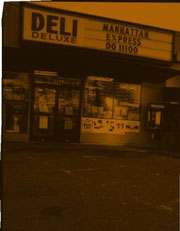
Welcome to Lower Queen Anne, another toxic Seattle neighborhood. Don’t expect belching smokestacks, mounds of junkyard scrap, or dilapidated factories. This isn’t the Duwamish. The hazardous-waste site here is the local mini-mart, Manhattan Express, a boxy one-story building at the foot of Queen Anne Hill. It’s a variation on the old roadside eatery that beckoned, “Eat Here and Get Gas”—except filling up wasn’t necessary. Locals could get gas merely by being in the vicinity of the store’s leaking underground gasoline tanks, their fumes drifting into nearby businesses and apartments and up the noses of passersby. The eye-watering emissions that date to the 1970s were sometimes so strong they drove people from their offices and rooms, while legal disputes over who did what to whom prevented a quick resolution.
The store is one of 850 places on the Washington State Department of Ecology’s Hazardous Site List, an official compilation of sites that pose health threats to humans and the environment. About 160 are in King County, almost 80 in Seattle.
Fellow polluters on the list include such giants of industry as Boeing, Shell Oil, PACCAR, and ARCO. But as the mini-mart case shows, toxic sites are not limited to the usual suspects in major industrial zones. They’re down the street, around the corner, part of the neighborhood—mom-and-pop businesses, the local cleaners, that old auto shop turned into a secondhand store.
An examination of stacks of public records at the DOE’s regional office in Bellevue made clear that in-city toxic pollution sites lie beyond the better-known contaminated neighborhoods, such as Georgetown or South Park, where battles over toxic spills and emissions have become part of daily life.
About four dozen Seattle neighborhood business properties are on the state’s Hazardous Site List. The roster of polluters includes apartment houses and private residences. One may be your next-door neighbor’s home, or your own. And once a property gets on the list, getting it off can be a time-consuming, difficult, and expensive process.
William F. Arnold, Manhattan Express’ elderly owner, died only a few months ago, and his wife Erma died in 1996. They, like others in similar situations, felt caught in a dispute over responsibility for cleaning up the spill as demanded by the state.
“Their family members sure believe that stress in dealing with this problem shortened their mother’s life,” says family attorney Mark Myers of Seattle, “and caused a great deal of problems for their father.”
Even with the Arnolds gone, their toxic battle lives on. To protect taxpayer interest and recover cleanup costs, the state Department of Ecology has filed a claim on the couple’s estate and has liens on the mini-mart property.
The ultimate price tag will be in the hundreds of thousands.
In a similar situation in Montlake, cleaning-business operator Jin Chong faces paying some of a $1 million state-ordered cleanup of a gas spill left by the previous land owner. “It’s just very unfair,” says Chong.
The Arnolds’ site, three decades after complaints were first made, is still being cleansed of chemicals that saturated the soils and drainage system below. Though the gas tanks and much of the contaminated soil were removed, a vapor and petroleum recovery system is still needed to scrub fumes.
Then there’s the case of Seberina Heraldo and her husband Rudy. The hazardous-waste site in their White Center neighborhood was their rental property.
“It drives me crazy to think of it,” says Seberina. In 1997, she and Rudy leased their second house, a home on 16th Avenue Southwest, to a man who used the backyard to recycle heating oil tanks and auto engines. In a short time, he contaminated the yard with lead and chromium. One neighbor reported that “oil and whatever is running all over the place.”
The Heraldos evicted the renter, who left owing them $9,000 in rent and other costs, says Seberina. A state ecology inspector, alerted by neighbors, found oil leaching through the garden rockery. He quickly declared the home an official state hazardous-waste site, subject to expensive, lengthy cleanup measures.
“It cost $6,000 to take away the dirt and clean up,” Seberina says. “Oh, it give me headaches. We sold the house; we quit the rental business.”
Told the home, nonetheless, remains on the state’s toxic site list (mainly so inspectors can continue their oversight), Seberina says, “Oh, maybe my headache is coming back!”
This problem is widespread. Above the Interbay valley, between Magnolia and Queen Anne Hill, the Burlington Northern Santa Fe rail yard and the Port of Seattle’s Terminal 91 tank farm got the worst ranking. This indicates the most serious kind of environmental threat to their surroundings and neighbors due to years of chemical spills, which are migrating through the ecosystem.
Obviously, these are industrial polluters—the usual suspects of most of America’s historic toxic waste. But they are neighborhood polluters too. The sites are encircled by commercial, residential, and recreational areas, from Fisherman’s Terminal to the Elliott Bay Marina at Smith Cove.
Their groundwater chemical spills, some carcinogenic, seem to be migrating toward both the bay and the Lake Washington Ship Canal. (The state’s list includes at least four major polluters around the Salmon Bay/Ballard Locks area of the canal.)
For contrast, a modern three-story office building in Madison Valley has made the state’s hazardous-waste hit list due to extensive spills of dry-cleaning solvents by a former cleaners.
The former taxi cab site above South Lake Union on Dexter Avenue North is destined to become home to an apartment building once it is cleaned of its toxic residue resulting from decades of petroleum spills.
A laundry-operation-turned-hazardous-waste-site on East Cherry Street made the list, as did a mirror and glass firm in Fremont, a house in Rainier Beach, an abandoned fabrication plant on Ballard’s main drag, and a former gas station site in Montlake.
These and the city’s other toxic-waste sites can affect the air we breath, the soils we turn, and the groundwater that flows into our streams, rivers, and bays. The results can be as simple as a headache, as serious as cancer.
It’s no epidemic—certainly not everyone in Seattle has a toxic dump, big or small, next door. And the threat is not immediate. A hazardous-waste site’s danger is in the effects from a long concentration and relentless migration of its chemicals.
“The state and Seattle aren’t much different than other states and urban areas,” says DOE spokesman Curt Hart. “Everyone everywhere is dealing with the results of historic dumping rather than treating our hazardous waste.”
The dumping, leaking, and seeping are policed by local and state authorities. The DOE snoops out suspected sites or responds to tips and complaints from other agencies and the public. Risks are measured, responsible parties singled out, cleanup decrees ordered, and costs assigned. Some violators decontaminate their sites voluntarily (usually by removing and treating the soil), others have to be sued.
Some site owners feel taken advantage of by a state system that penalizes those who unwittingly buy toxic sites.
Take Jin Chong’s case. When the Circle K gas station/mart on 24th Avenue East in Montlake closed its doors a decade ago, it was replaced by several modern buildings including Jay’s Cleaners. Unknown to new owner Chong, his cleaners was sitting atop a 6,000-gallon gas leak that, a later review of records would show, drained into the soils from June to August 1989.
Discovered after Chong bought the property, the spill had spread through the local groundwater and drainage system. Fumes could be smelled blocks away at the Museum of History and Industry building or in the Arboretum.
The tanks have been removed, contaminated soil hauled away, and remedial cleanup continues. But the Circle K Corp. declared bankruptcy years ago, and Chong is stuck with part of the cleanup tab. “It must be a million dollars,” he says, unsure how much of it he’ll end up paying (the state is a creditor in the Circle K bankruptcy). “I’d like for this to just go away.”
Similar legal and bureaucratic battles are also prominent in the saga of the redolent Lower Queen Anne mini-mart, the poster child of toxic neighborhood sites.
The records date back to 1988 when a nearby apartment owner wrote a letter complaining about the choking fumes at the mini-mart, first named Arnolds’ Mini-Mart. Even then, the manager said, “We’ve been living with the problem for 10 years.”
A year later, a DOE official replied to say a squabble had erupted over responsibility for the hazardous petroleum leaking into the drains and ecosystem beneath the intersection of Queen Anne Avenue and Roy Street. “I regret,” the official noted, “I cannot tell you when this problem will be solved.”
The state still can’t tell. The DOE ranks hazardous-waste sites on a scale of 1 to 5 based on the threat to humans. The worst is 1—the usual ranking of major indus- trial sites such as Boeing’s Renton and Seattle plants.
After more than 10 years on the list, the mini-mart remains a 3.
Though gas smells have been lessened to the point that chemical-odor alarms are no longer required at several near- by apartment buildings, the end is not in sight.
Just prior to William Arnold’s death, former property owner Texaco was handed at least partial responsibility to finish the mini-mart’s cleanup. In December, Texaco proposed to do the job its way without having the DOE look over its shoulder. The DOE said no.
Back to plan A.
“These things take time,” says DOE spokesman Hart. “Some more than others.”
Toxic by numbers
Here’s a look at some hazardous sites— big and small—in Seattle neighborhoods, taken from the Department of Ecology’s official list, along with rankings and the history of some sites. They comprise about one-tenth of the 850 statewide cleanup properties (including 90 Superfund/federal sites). Find the complete statewide Hazardous Sites List online at www.ecy.wa.gov/programs/tcp/ mtca_gen/hazsites.html (updated every six months). Document files on each site are available for public review by calling the DOE’s Bellevue office at 425-649-7190. To get onto the state’s Hazardous Sites List, a polluter’s property must come to the attention of the DOE, either through its own scheduled random inspections or from outside tips. Some property owners, following the law, have also reported their own waste sites. “Many people want to do the right thing environmentally,” says DOE spokesman Curt Hart, adding that the state has cleaned up some 8,800 sites in the past decade. “And many we have to take to court.” A preliminary study of a suspected hazardous site results in a numerical ranking of 1 to 5; 1 and 2 are most serious. The sites’ contaminants—their history, type, amount, toxicity, and possible exposure to life forms—drive the rankings. The ranking is used to estimate the potential threat to human health and the environment. A remedial action follows, which can include further study or quick partial cleanup. A full cleanup done with DOE oversight then follows and can last years. Those deemed responsible must pay for the cleanup, though the state pays some costs. It can be expensive—Seattle City Light paid more than $300,000 for just one phase of its cleanup of the old Lake Union Steam Plant, which is still on the hazardous list because of lingering but low-level PCB remnants. Taxpayers can pay heavily as well, facing millions in costs—for example, on the ongoing cleanups at King County/Metro Transit
sites and Gas Works Park. Caveat: Persons currently occupying these sites aren’t necessarily liable for the cleanup.
1. Ballard/North Seattle
- The old aluminum-fabricating plant on Northwest Market Street, next to the Ballard Locks, is ranked 5 and is in cleanup stage. Its 10 leaky underground storage tanks have been removed, and now the contamination—paints and petroleum—is being treated or removed from the soil.
- Other sites: Ballard Auto Wrecking, 2; Ballard Recycling, 3; Bardahl Oil, 3; Western Batteries, 3; Laurelhurst Oil, 4; Salmon Bay Steel, 5; General Disposal, 5; Aurora Cleaning/McAbree Property, 5.
2. East Central/Montlake
- The former L&E French Cleaners site in Madison Valley is now occupied by a modern building whose owners, originally unaware of old dry-cleaning solvents contamination, are just beginning the extensive sanitizing; the site is ranked 2 because chemicals have migrated off the property as well as beneath the new structure.
- Other sites: Circle K site, 3; Olympian Apartment Building, 4.
3. Capitol Hill/First Hill/ South Central
- The now fenced site of the old Tyler Refrigeration/laundry operation across East Cherry Street from Seattle University is actually a donated trust property of Seattle Pacific University Foundation, which is cleaning up the site, ranked 2; chemicals from electroplating and dry cleaning had been spilled or dumped at the site dating back to the 1940s.
- Other sites: Ralph’s Concrete Pumping, 3; Emerald Tool, 5.
4. Downtown
- Yellow Cab’s old site on Dexter Avenue North bears few obvious traces of its days as a sprawling cab parking lot and service area; its buildings, fuel storage tanks, and buried drums have been removed, and cleanup undertaken. But it’s still ranked a 5 almost four years after a DOE inspector showed up and noted, “They have left behind a huge mess.” A mixed-use apartment building is planned for the site when cleanup is done.
- Other sites: Metro Transit Dearborn Division, 3; Union Station, 3; Unocal/future waterfront sculpture park site, 4; Seattle Steam Co., 5; Samis Land Co. site on South Alaska Street, 5.
5. Fremont/Wallingford/ Lake Union
- Hy-Lite Mirror and Glass on Stone Way North is ranked 4 and is in the ongoing process of cleaning up lead and mercury found in its grounds, coming from rinse water used in a mirror de-silvering process.
- Other sites: Metro Lake Union facility, 1; Gas Works Park, 1; Lake Union Dry Dock, 2; Northlake Shipyard, 4; Ravenna Landfill Union Bay, 4; Lake Union Steam Plant, 5.
6. Harbor Island
- Essentially, the island is one big cleanup site—the man-made and polluted isle is listed as a US Superfund site, undergoing costly and lengthy cleanup; the Duwamish Waterway is expected to be added to the Superfund list soon. Among sites under state cleanup orders are Glacier Northwest/Lone Star property and Lockheed Yard, both ranked 1 in cleanup priority.
7. Magnolia/Interbay
- Burlington Northern Santa Fe railroad at Interbay, ranked 1, has been cleaning up its spills and leaks for more than a decade, putting a new bottom on its 2.4 million gallon above-ground diesel fuel tank and treating or removing contaminated soil; inspectors note that fuel oil is most heavily concentrated nearer the water table.
- Other sites: Anderson Marine Repair, 1; Port of Seattle Terminal 91 tank farm, 1; Samis Land Co. site on Elliott Avenue West, yet unranked.
8. West/South Seattle
- The Eastern Supply Co.’s former site on First Avenue South at 77th is ranked 2, partly due to dangerous tetrachloroethylene leaching into the soil of the onetime laundry-industry supply; cleanup is under way, and inspectors say chemicals have already migrated to adjoining private properties.
- Other sites: Metro South Base, 1; Great Western Chemicals, 1; SeaCon/Markey Property, 3; Stone residential site, 5.
9. Queen Anne
- The Champion International Corp.’s old plywood and veneer mill site on 13th Avenue West at the ship canal dates back to the turn of the century; converted and now used by other industries, it retains high concentrations of resins, solvents, and paints and is ranked 1 as a hazardous site. Cleanup has been ongoing since 1991.
- Other sites: Manhattan Express, 3.