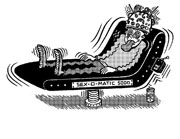
IF BRITISH RESEARCHERS have their way (and they will), in the near future you’ll pop a disk into your digital device, plug a wire into your neck, and play a recording that will let you feel every thrust, parry, and riposte of a night in heaven with the woman or man (or gender-ambiguous entity) of your fantasies.
In words of one syllable, the stuff dreams are made of will at last have come to pass. And while a Wired cover story and a feature-length interview on National Public Radio hardly constitute the media’s ignoring this amazing piece of history in the making, it’s actually surprising that even more fuss isn’t being made about the matter.
Here are the facts: For nine days in August 1998, Kevin Warwick, a professor of cybernetics at the University of Reading near London, walked around with a chip implanted in his arm that allowed him to do all sorts of 2001-ish things throughout the office.
Doors opened as he (and he alone) approached, lights turned on and off as he entered and left rooms—all because the microtransmitter embedded in his flesh allowed a computer to monitor and react to his presence constantly.
Certainly a case could be made that Warwick’s implant was merely a somewhat more sophisticated version of duct-taping an automatic garage door opener to his forehead. Nevertheless, Warwick feels his experiment went several giant steps beyond that, simply by virtue of the implant itself, because wearing a chip inside his arm was preparation for the profoundly more ambitious project now under way.
“An important part of the reason for that first experiment was for me to actually experience having a transmitter inside my body,” Warwick said in a recent interview, “to have the physical realization of what it’s like. With all we’re doing in the next stages, it’s really the same concept. We’re using roughly the same transmission pathway to send out whatever signal is there.”
This next stage is the killer. In a short time—summer of 2001 is the outside date, but Warwick feels his team will be ready earlier—he will undergo a new implantation of a two-way neural transmitter. A tiny “cuff” will sit around a main bundle of nerve fibers in his left arm and will capture and relay signals directly from his nervous system—a whole range of commands, sensations, and emotions.
These faint electronic signals, the sort normally shuttling back and forth between our brains and our bodies every instant of our lives, will be monitored, digitized, and recorded.
Then, they’ll be played back over Warwick’s own nervous system, essentially allowing the computer to recreate the commands, sensations, and emotions he experienced initially. In a portion of the experiment, researchers will also send Warwick signals that the brain can’t usually process, such as X-ray, ultrasound, and infrared data, to see how his mind handles them.
“It’ll be like a remote-controlled body, I suppose,” Warwick said. “It’s the next step in the experiment, trying to see what the brain makes of those signals.” For the apocalyptically inclined, the notion of an implanted “mark of the beast,” a chip embedded in living flesh, resonates more luridly than any mere clip-on ever could, whether that mark is used to open a garage door, access the Internet with a thought instead of a keystroke, or record and replay the climactic moments of a wedding night.
ODDLY ENOUGH, no other researchers seem to be experimenting in this precise area. The Reading research team consists of about 20 scientists, including a neural prosthesis specialist, a cybernetics expert from the United States-based Rehabilitation Robots Laboratory, and teams developing intelligent networks and biomedical signal processing software. However, Warwick says none of the technology being used is new. The monitoring devices, the programs to convert nerve signals into digital data for capture and replay, all exist in related fields, most notably in pain-monitoring systems and in controls for high-tech prosthetics.
Warwick’s experiment will last for about two weeks. If all goes well, a third stage will follow immediately, in which Warwick’s wife will undergo implantation too. For this phase, there’s good reason he’ll need someone with whom he’s intimately connected because—while the team plans to capture such basic information as simple movements of fingers and simple sensations like heat, cold, and pain—they also plan experiments of a more intimate nature.
“How far could we go in transmitting feelings and desires?” Warwick wondered in his Wired article. “I want to find out. What if the other person became sexually aroused? Could we record signals at the height of our arousal, then play these back and relive the experience?”
When asked to elaborate on the erotic aspects of his work—and the implications for artistic creation and mass entertainment in general—Warwick responded enthusiastically.
“There’s most definitely the possibility of a new entertainment medium here,” he said. “You could even regard it as a kind of electronic game-playing, recording and playing back extreme feelings, sexual experiences. Let’s be blunt about it: There are electrical signals flying around your body at such times; if you play back the same signals, our best guess is that you’ll get something of the original sensations.”
The term “multiorgasmic” will take on a whole new meaning, as will “instant replay.” Pleasurable (and painful) sensations will likely be reproducible at will, and researchers will also explore the effects of playing back the body’s reaction to drugs—hoping to recreate the effects without the chemicals themselves.
Warwick predicts the relatively simple neural recordings he and his team first make will soon develop into more sophisticated ones. “We’re at the very earliest stages, as people once were with sound recording or telegraphy,” he said. “What we’re doing here will lead to the equivalent of stereo, then quadraphonic, then surround sound.”
HOW WILL THIS new medium develop? Barring any breakthrough, it seems likely those wishing to experience it will need a microtransmitting implant—certainly a higher level of commitment than slapping on a set of headphones or 3-D glasses. But in these days of faddish body modification, from tattoos and piercings to hair plugs and stomach staples, there’ll likely be masses of people unsqueamish enough to sit still for such an operation.
Then, too, the payoff will be far more intense than such old new-media turkeys as Mike Todd’s 1960 Smell-O-Vision, and will make today’s so-called virtual reality devices look like Smell-O-Vision themselves.
Among the first prerecorded products available will likely be erotic encounters, but other intense sensory experiences will be in demand as well. If poor Orson Welles were still with us, he could record his orgasmic enjoyment of a 10-course meal (shall we make that 20, Orson?). And we’ll be able to savor all sorts of risky behaviors, from skydiving to cigar smoking, in a risk-free way.
Warwick’s scenario could lead to a closer and closer alliance with intelligent machines, to the point where the very definition of “human” changes. When we all sport cyborglike “enhancements” that extend our capacities and perceptions and feelings, yet put us at the mercy of intelligent machines—when those machines control more and more of the fine details of our existence with each passing day—exactly what will it mean to be human? And where will humankind end and machine-kind begin?
Time, and experiments such as Kevin Warwick’s, will tell.