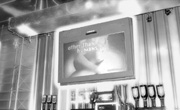
AT SEATTLE’S ANNUAL jazz festival this year, patrons attending a sold-out show at Tula’s, the beloved Belltown jazz club, got eyeshot as well as Earshot. There was something new in the air: Optic nerve-splitting images insistently flashing throughout the concert in an effort to steal the spotlight, succeeding only in ruining the experience for those held captive within sight line of the video monitor. When several patrons asked the bartender to turn off the television, he told them he couldn’t turn it off. Switching off this TV would invalidate the club owners’ contract with SignCast Inc.
SignCast is a New York-based start-up controlled and funded by Home Box Office (HBO), a subsidiary of Time Warner, along with Samsung Digital and the advertising conglomerate IPG. The company’s stated mission is to become “the world’s first fully interactive broadband distributed digital network.” If you haven’t seen it yet, consider yourself lucky. SignCast wants to take the “home” out of Home Box Office and the remote control out of your hands.
The company has already invaded Chicago and Las Vegas and is making steady incursions into San Francisco and Seattle. The company claims that over 1,100 venues are signed up in 22 urban markets across the country, with an aggregate reach of nearly 2 million viewers a week. SignCast is part of the ambience at local venues as diverse as Art Bar, Last Supper Club, Neighbours, Old Timer’s Cafe, Tula’s, and Zasu.
Because SignCast content is specially designed to work with the sound off, the images must scream, and scream they do (in a pathetic sort of way). The video is fast cut, glossy, and dripping with sensational and pseudo-sexual content. Standard fare includes an unpalatable spread of chopped-up HBO programs (such as G-String Divas) and seriously sleazy stuff like Portable Peep Show, Fetish Fashion, and Cab Chronicles (people getting down and dirty in taxis). Also in the mix are video hit singles from Virgin Records and promotional stuff from AtomFilms’ independent artist series.
Venue owners that sign up with SignCast agree to let the company broadcast its peculiar blend of branded media nonstop during business hours. In return, the venue gets a monthly check of $100 to $300. It doesn’t sound like much, but some club owners say they need that cash to make ends meet. (Other club owners claim to be receiving much more but did not want to speak about SignCast on the record.)
The company also installs and maintains all the equipment for the clubs, including an on-site computer equipped with DSL and a wide-format 40″ Samsung digital flat-panel plasma monitor. “The monitor alone is worth $10,000,” says one club owner. Technically, you can use the gear to view something other than SignCast, but that is a violation of the contract.
Juan Norriega of Old Timers Cafe signed up with SignCast in early summer. He supports the basic concept of the service (advertising and promotional content with a nightlife theme) and especially likes the SignCast Hit Dance Singles. “They add to the ambience on Friday and Saturday nights when we have live bands and salsa dancing.” However, he isn’t wild about some of the more blatantly sexual content (his wife feels even more strongly about it), and images of violence are where he draws the line. “The last thing I want,” says Norriega, “is violence in here while people are drinking.”
VENUES RECEIVE the content—a 30-minute loop that changes each month—via Internet protocol-based broadband sent from SignCast’s network operations center in Boston. SignCast’s digital media network infrastructure enables distribution of content and advertising that can be tailored to each club. The company promises content that is “customized by type, venue, time of day, geographic region etc., including self-promotional messages created by each venue.”
However, there is no evidence so far of any venue-specific stuff in Seattle. On the contrary, the same loops play over and over again, regardless of each club’s unique patronage or even the time of day. (We saw all of the really sleazy stuff in the middle of the afternoon.)
The pitch to advertisers that buy time on the SignCast network is that they will be able to create interactive promotional point-of-sale schemes, such as contests, giveaways (coupons, coupons, coupons), and various special offers, to deliver customers to advertisers on the spot.
A publicist for SignCast says this kind of “interactive functionality is already operational” and that the company is “actively field-testing it to develop compelling applications.” Although the technical details are sketchy, here’s a possible example: A beer ad is narrow-casted to a bar. Cell phone-wielding patrons are instructed to punch in a two- or three-digit number for a special discount price on the advertised beer. By flashing the confirmation message on their cellular phone (or PDA) to the bartender, patrons get the advertised beer at half-price (dude!). If you think cell phone users are annoying now, brace yourself—the cacophony only promises to get worse.
Venues are sold the idea that they can create tie-ins to these promotional schemes to boost sales of a particular product in their establishment. “Our ads are packaged and delivered with other creative content in an environment . . . where ads can lead directly to purchase,” says SignCast CEO David Tanzer.
According to SignCast, a San Francisco club owner running Stolichnaya vodka and Malibu rum ads wrote to the company with this enthusiastic testimonial: “Since installing SignCast screens in my bar, sales of Stoli and Malibu rum have doubled.” However, one local club owner, who did not wish to be named, said he hadn’t seen any indication that SignCast had affected alcohol sales one way or another, though he is willing to give it more time.
Although SignCast lists plenty of advertisers on its Web site, the most notable thing about the ads is their absence. There’s lots of promotional stuff but very little actual product-based advertising. In fact, during the several weeks when we viewed the broadcast, the only product you could actually buy and consume was Sauza Tequila.
Beer and alcohol sales are just the tip of this iceberg. SignCast plans to spend more than $75 million on installations to extend its reach beyond nightclubs and casinos to gyms, health spas, salons, bowling alleys, cafes, restaurants, you name it.
“We are going to be the Blade Runner of venue advertising,” says Leonidas Addimando, vice president of business development at SignCast.
If you fall into its target demographic of 18- to 34-year-olds, the company has you squarely in its crosshairs. Whether you are listening to live music, hanging out in a cafe, getting a haircut, working out in the gym, or enjoying dinner conversation with friends, SignCast wants to be in your face.
It’s too early to determine if the enterprise will fly or fizzle. However, one thing is clear: Time Warner/HBO and IPG are having the same wet dream: to project a fully interactive Blade Runner dystopia on your favorite night or day spots, everywhere, that is, except the one place where you still have access to the off button.
Watch out or, better yet, keep your eyes wide shut.