
A DRUNKEN CONVERSATION I once had in Portland came around to the subject of Pacific Northwest natives and their collective inability to play, or accept someone else playing, devil’s advocate. If there’s another side, people here don’t wanna hear it. Or do they?
This psychological tic makes discussing the Experience Music Project about as productive as trying out your high-school French on a Parisian. Before the doors—are there doors?—have even opened, everyone in Seattle has an opinion about the strangely shaped, supersecret, somehow-Jimi-Hendrix-related music and technology theme park opening next week, and of course it’s either love or hate. Love Frank O. Gehry’s futuristic design. Or hate it. Love the idea of starting an alternative to Cleveland’s Rock ‘n’ Roll Museum in the town that, coincidentally, started alternative rock. Or hate it. Love that Paul Allen has enough cash to build Seattle’s latest and most ostentatious landmark (for upwards of $240 million). Or hate him for it.
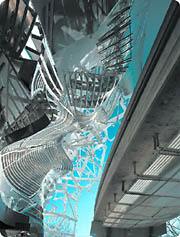
Here’s the crux of EMP: Paul and his sister Jody Allen Patton wanted to create a place for people to experience their beloved Jimi Hendrix and, in time, rock music in general, the way they do. BUT, and it’s a very big but, the museum has spiralled off to become as twisted and complex and challenging to the imagination as the smashed-up guitar architectural statement Gehry chose to make with his commission. When EMP opens, visitors will step inside a museum that’s also a technological showcase, an educational institution, a research facility, a brick-and-mortar (or rather steel-and-plywood) companion to the Web site emplive.com, and a musical amusement park. Or is it a concert venue, a restaurant and bar, and a tourist trap? In a town that doesn’t like to be faced with conflicting viewpoints, EMP confronts us with a gaggle of facades, and its mission statement—”EMP celebrates and explores creativity and innovation as expressed through American popular music and exemplified by Rock ‘n’ Roll”—is now neither accurate nor clear. Still, it’s difficult to judge something unless you’ve seen it from the inside, right?
MY BUILDING HAS EVERY CONVENIENCE
I’ve been graced with two preopening tours of EMP, once when the project was in its early stages and once for a media walk-though about two weeks ago. Despite its convoluted exterior, it’s even more mind-boggling from the inside than from the outside. The first thing you notice is that the contours Gehry stresses on the shell translate to the interior; the architect used a 3-D electronic modeling program called CATIA that not only draws the blueprints but shapes the metal. On the recent media tour, our group entered between the southeast and northeast side of EMP and climbed an Alice in Wonderland-like staircase up to one of the marquee sections, Sky Church. This cathedralesque room will be the first one visitors enter; a monstrous wall of screens flashing fast-cut images and a bone-rattling sound system under an 85-foot-high ceiling give fair warning that EMP reserves the right to assault your senses.
From Sky Church you can access a hall leading to the galleries or you can pass through a courtyard and watch the Monorail scoot by overhead, then proceed to Artist’s Journey, which sounds a bit like the Peter Pan ride at Disneyland, only starring James Brown instead of Tinkerbell. (EMP hasn’t previewed the ride yet.) The main building (I think; with over 140,000 square feet, it’s fairly easy to misplace yourself) houses a spectacular collection of rock memorabilia, plus exhibits dedicated to punk and hip-hop, an interactive music room (“Sound Lab”) where you can live out your rock star fantasies, a Hendrix Gallery, and an entire section (“Northwest Passage”) devoted to regional-themed items as wide-ranging as Kurt Cobain’s handwritten lyrics and Paul Revere and the Raiders’ gaudy period uniforms. Oh, there’s more, but I’ll leave some of the trickiest tricks for your firsthand surprise.
MONEY CAN’T BUY ME LOVE
In his business dealings as owner of the Seattle Seahawks and Portland Trailblazers, and as a cable mogul and high-tech visionary, Paul Allen doesn’t seek out rifts, but that doesn’t mean he avoids them. EMP has had a surprisingly smooth ride where public comment is concerned, yet behind-the-scenes sniping hasn’t been this intense since the Nirvana-Pearl Jam credibility debate of ’91. The artists and music industry players who created the climate that allows EMP to even exist in Seattle are decidedly split on the matter. Some have climbed on board directly. Among the many musicians and indie entrepreneurs who’ve gone to work for EMP are K Records cofounder Candice Peterson and Shuggie’s Andrew McKeag. EMP employment can have its benefits; McKeag recently was charged with recording guitar licks played through effects pedals that originally belonged to Jimi Hendrix (“He didn’t mind that too much,” says a coworker).
Sub Pop owner Jonathan Poneman counts himself among those in EMP’s camp. His label worked with EMP to develop CD compilations of funk and Northwest rock, and he says the museum’s presence will improve Seattle’s stature as a burgeoning international city. “If they pull it off, it’s gonna be a boon to the community and to Northwest music,” he says.
Others aren’t so enthusiastic. Sunny Day Real Estate guitarist Dan Hoerner, an outspoken critic of urban environments in general who lives on a 40-acre plot of land in Eastern Washington, says his band refused EMP’s request to lend pieces of artwork from its 1992 album Diary for an exhibit. “I think that’s one of the ugliest pieces of architecture I’ve seen in my life,” he says. “It totally reminds me of the quality of an Arizona gas station, kinda kitschy, utterly random, just stupid. I hate it.”
WELCOME BACK MY FRIENDS TO THE SHOW THAT NEVER ENDS
Equally controversial is the cost of admission. EMP touts membership as a bargain, and it is in comparison to buying a single ticket, which costs a whopping $19.95. Membership ranges from $35 to $5,000 and includes unlimited access to the museum, first-chance tickets to special events such as the grand-opening weekend concerts, and a better crack at making reservations to get in.
You see, EMP can hold 2,250 visitors in the exhibition area at any one time, and the interactivity of displays will require a certain flow to prevent long lines. Officials predict the average stay will be three and a half hours, and estimate EMP can accommodate about 8,000 visitors per day (and 800,000 per year).
As for the hefty ticket prices, well, they’re not all that much more than the cost of an art museum in a major city like New York; a trip to MOMA will set you back a 10-spot. And while you’re ogling those Dalis and Magrittes, you won’t experience anything like what EMP’s got in store for you, technologically speaking.
OK COMPUTER
This being the house that Microsoft cofounder and Vulcan Ventures head Paul Allen built, EMP is as much a technology showcase as a museum filled with rock memorabilia. Everyone who enters the building will be given a Museum Exhibit Guide (MEG) to carry while touring the exhibits; designed specifically for EMP, this device is like a Palm Pilot attached to a mini-hard drive, which you’ll wear on a shoulder strap. They’ve got 2,500 of these puppies rarin’ to go, and I imagine that the 30 full-time employees in EMP’s technology department will spend a large chunk of their time repairing and fine-tuning MEGs once things get humming.
How does MEG work? Say you’re staring at a glass case containing Janis Joplin’s bell-bottoms and you’re curious about the embroidery. You point MEG at a designated spot, and boom, a voice comes through the headphones and blabbers on about her hard-drinkin’, “Me and Bobby McGee”-singin’ ways. But no word on the stitching. So you press the bookmark button on MEG and later, when you’re through with the exhibits and have turned in the MEG (which gets docked so the data can be abstracted from it), you can head down to a computer lab-like room and, using the number from your membership card or ticket, access tons more information. Eventually, you’ll even be able to do this through EMP’s Web site from your own home—and maybe even find out how that groovy pattern got stitched into Janis’ pants.
Now I’m a bit of a tech head, and to me MEG sounds infinitely more intriguing than Janis’ pants or Jimi’s guitars or Kurt’s chicken-scratch lyrics. So I headed over to EMP’s Green Room in South Seattle and scoped out MEG first hand. A 6 MB system running Windows CE, MEG will contain 1,100 audio clips (in MP3, natch) and 10-plus hours of overall content. It’s got an infrared scanner and lights up the side like something out of Buck Rogers; they flash red when you’re missing your data-providing target and green when you’ve hit it. If you’ve ever worn one of those silly Walkman museum guides, prepare to be dazzled.
“I don’t think EMP set out to obliterate what came before it,” says Diane Andolsek, director of online development. “We’re trying to find a new way to present information.” She’s being modest.
THIS IS THE END
A recent drunken conversation I had with friends at Linda’s led to a discussion of whether EMP, with its Hendrix- and grunge-centric focus, was really necessary or even relevant, given that Seattle’s star, musically speaking, has faded almost out of the horizon. Before long, I received a lecture about all those poor lost souls who come here seeking out landmarks only to find that beyond Jimi’s grave and a few persevering clubs, there ain’t much. Kurt and Courtney’s house was sold, the garage knocked down. Thrift stores don’t have much flannel anymore, as it’s gone out of fashion. Sub Pop’s Poneman says these fans are so desperate that they sometimes show up at his office unannounced. Now, they’ll all have some place to go. It may not look pretty at first (I’m sure heady architecture magazines will decide its aesthetic legacy), and, philosophically speaking, it may be random to plop down an ultra-high-tech music museum in Queen Anne. But for once, something is setting Seattle abuzz, pitting skeptics and antiexpansionists against those who see this as a growing, exciting place to live and EMP as a part of this.
Modest Mouse’s Isaac Brock, whose song lyrics typically skewer the modernized landscape, surprisingly comes out in favor of EMP. But his reaction may have as much to do with EMP’s unintended role as a catalyst for discussion, for challenging the staid Northwest attitude toward debate. “I don’t really understand it yet, I don’t know what it’s about,” he says. “It’s a pretty goofy-looking building. I can’t tell if it’s supposed to be some big piece of . . . pocket lint. But I kind of like it because . . . at least it’s something to talk about, complain about, or whatever you decide to do with it. As long as it’s interesting.”
It’s hard to argue with that.
EMP Grand Opening Weekend, June 23-25; for ticket information, visit emplive.com or call Ticketmaster at 628-0888.
Laura Learmonth contributed to this article.
Check out Special Coverage: Experience Music Project.