A GREAT MYTH of pop culture intimates that only a few thousand people owned a Velvet Underground album during the quartet’s brief tenure in the late ’60s as the soundtrack providers for New York’s hedonistic art crowd, but every one of those people formed a band. Whether this exaggerates a group of musicians’ importance is secondary; the implication that an inner sanctum sustains and nurtures an alternative to mainstream ideals, and in turn influences those ideals, remains trenchant.
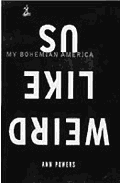
Weird Like Us by Ann Powers (Simon & Schuster, $21.95)
If such a taste conspiracy exists, its most delicious aspect is that it’s impossible to infer who’s at the controls. At least, the chauffeurs of the cultural bandwagon change form indiscriminately; one minute something or someone is “hip,” the next even the use of the word implies a lack of awareness. One thing remains certain: Those who feel they’re among this underground elite will refuse to admit when they’ve expired.
A pop music critic for The New York Times, Ann Powers is struggling with her relevance. Raised in the then-budding outpost of counterculture, Seattle, she absconded to San Francisco and began to forge a life on the fringes, what she calls “My Bohemian America” in the subtitle of her new book, Weird Like Us. Now in her mid-30s, she’s a married homeowner who lives in Brooklyn and writes for this country’s preeminent newspaper.
And she writes well, employing her hard-earned knowledge of pop music and its trends to inform her concert reviews that appear regularly in the Times‘ Arts and Leisure section. Now she’s taking a tremendous step forward, examining her own rise and assessing the paths taken by many of her friends, some of those brave souls who’ve steadfastly scripted their own version of the American dream. In almost every case, this translates to a skewing, if not a complete upheaval, of the suburbanite’s notion of success.
But there’s the sticky problem of identifying this ill-defined populace, and Powers misfires in her terminology. Only a non-city dweller, or a particularly old-fashioned one, would categorize someone as “bohemian” in the year 2000. Still, she persists. “And so I declare ‘bohemia’ resurrected,” she writes, “although it has lost that tarnished title and adopted a new group of aliases: slacker, genderfucker, riot grrrl, hip-hop nation, ecotopia, recombinant techno-revolution.”
POWER’S STRENGTH—and undoing—is this ability to manipulate language, to infuse questionable or even contradictory statements with gravity. As she bounces from anecdote to anecdote, summoning either her own war stories or those of confidantes—flatmates from San Francisco, fellow former record store clerks, veterans at the alternative weeklies where Powers honed her skills—her fluid narrative style becomes a distracting weapon. Musing at length on sex, drugs, and, of course, rock ‘n’ roll, her discourse takes stabs at pop psychology or zooms in on class division; in a section called “The Cultured Proletariat,” she halfheartedly endorses a theory that companies should allow workers to steal a sustainable amount of product, as it will allow these bohemians to justify their minimum wage jobs. Yet she’s also obsessed with the idea of selling out and defends herself vigorously.
Dwelling on asides and her personal life, Powers passes up a golden opportunity to assay the unraveling of the weightiest term attributed to her kind: “Generation X.” Just 10 years ago, mainstream cultural guardians sneered with contempt at this mass of insolent, angst-ridden young Americans, but the sneerees are now at the heart of the rumbling Internet economy. This perspective eludes Powers completely, even though many of her peers in the Bay Area, Seattle, and New York play significant roles; indeed, a stroll through the halls of a high-tech company in San Francisco’s SOMA district or even Microsoft’s campus will reveal a shocking portion of the musicians who brought about the “alternative rock” revolution of the early ’90s.
That may be a different book than the one Powers set out to write, but her decision to assess what’s left of that era’s influence vis ࠶is her path from record store clerk and free-spirited San Franciscan to not-quite-settled-down culture maven for the Times makes Weird Like Us read like a book-length self-justification. Delivering only a trickle of acute sociological commentaries, Powers has written something antithetical to thebohemian lifestyle: a memoir.
Ann Powers reads at Elliott Bay Book Co. on February 19 at 7:30pm.